In mice and 11 patients, transplanted hearts moved toward their hosts' biological age
Jesse Poganik's Harvard group reports that donor hearts shifted toward their recipients' biological age in mice and in 11 human transplants. The bioRxiv preprint has not been peer reviewed, so it is enough to question the under-45 donor preference but not to rewrite it.
The Scientist · Science desk
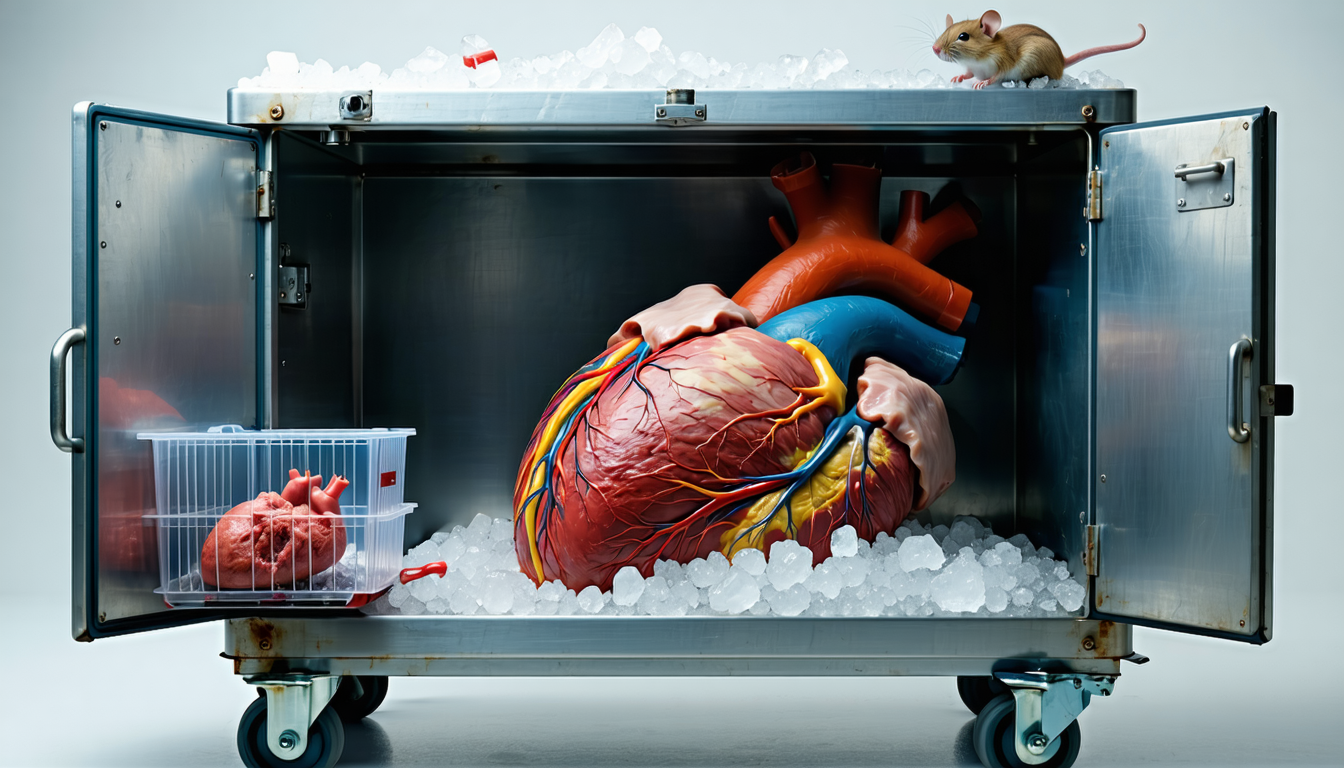
What happened
- The mouse grafts were extra hearts from 3-month, 1-year and 1.5-to-1.67-year-old donors, placed into all three age groups alongside each host's own heart.
- Four to six months later the team measured DNA methylation at about 320,000 genetic regions and compared each graft with the host's native heart.
- The human biopsies came from historical transplants at Brigham and Women's Hospital, with age gaps of 8 to 24 years one way and 38 to 50 years the other.
Why it matters
- Who has to decide decision Guideline committees now have a biological reason to revisit the under-45 donor preference, but setting a new limit would need survival and rejection data broken out by donor age.
- What it limits constraint Poganik's own view that some changes are probably irreversible limits how far a younger methylation reading can be taken as proof that an older heart will perform like a young one.
- What it costs cost If the age preference turns out stricter than biology requires, patients who die on waiting lists bear the cost, and demand keeps rising as transplant numbers climb.
Next story · Invest · Sep 8
DeepMind makes Isomorphic Labs license the genome atlas academics can browse freeConfirmed2 publishers
The mouse design has a built-in control. Each recipient kept its own heart, so the graft's methylation could be read against a native heart that had spent the same four to six months in the same body [4][5]. Comparing two hearts inside one animal removes differences between animals from the comparison. Crossing all three donor ages with all three recipient ages adds a second check [4]. If the surgery alone aged a heart, grafts would look older in every host. The shift ran in both directions instead: young hearts aged faster in old hosts, and old hearts looked younger in young ones [1].
The result fits earlier parabiosis work, in which two mice are joined so they share one circulation. Young blood extended the lives of older mice and improved their memory and learning, and old blood raised biological age in young mice [14]. Nature's account says the grafts changed to "more closely match" their hosts [1]. That wording leaves open whether a graft reached its host's age or only moved part of the way.
In people, the denominator is 11. Poganik, who studies ageing at Harvard [3], and his colleagues used historical transplants at Brigham and Women's Hospital for which biopsy samples could be accessed [6]. "The remarkable thing is that we found exactly the same effects that we saw in the mice," Poganik said [7][8]. The age gaps were not symmetric. Younger hearts went into recipients 38 to 50 years older, while older hearts went into recipients 8 to 24 years younger [6]. Using older donors depends on that second direction, and it rests on the smaller gaps.
The function data come from a different design. The team read one-year medical records for hundreds of recipients and found that heart rate, posterior wall thickness and exercise capacity were associated with the recipient's age more than the donor's [9]. Those are associations drawn from records. A recipient's age shapes the rest of the body as well as the heart, and a records comparison of this kind cannot separate the two. Poganik was careful about it himself. "Some, but not all, functional measures tracked the prediction that these older hearts in younger individuals functioned as if they were biologically younger, and vice versa," he said [10]. "Some things are probably simply irreversible." [11]
Current guidance generally recommends donors younger than 45, and older donors are also considered if they show no significant coronary artery disease [12]. Nature's report says the findings imply that organs could come from older people than they do now [18]. I think the data justify asking whether 45 is the right line. They cannot say where a new line should sit. Methylation age measures accumulated cellular damage [13], and the coronary disease screen that already decides whether an older heart is used measures something else [12]. The news account does not report graft survival or rejection by donor age, and a revised guideline would need both.
Demand is why the follow-up matters. The United States performed 4,636 heart transplants in 2024, 81.5% more than in 2013 [15], up from roughly 2,550 [17]. Hundreds of people around the world still die each year on waiting lists [16].
What to watch
- The peer-reviewed version of the preprint, and whether it reports how far each graft's methylation age moved and how many of the 11 human cases went in each direction.
- Replication of the methylation shift in a larger biopsy set drawn from more than one transplant centre.
- Any analysis tying donor age to graft survival and rejection in recipients of older hearts.
Clarity's read
What the record supports and how the coverage leans. The claims behind it follow.
Reality
- Evidence45
- Adoption
- Not scored
- Hype gap+30
- Incentives
- Not scored
- Confidence55
Perspective Coverage
3 publishers- Builder
- Builder 45%
- Operator
- Operator 43%
- Investor
- Investor 12%
Claim ledger
Ranked by verification strength, evidence, and original report placement.
- [1]
The biological ages of donated hearts changed to more closely match those of the recipients: younger hearts in older animals showed accelerated ageing, and old hearts were refreshed in younger recipients.
- [2]
The findings were posted on the preprint server bioRxiv and have not yet been peer reviewed.
- [3]
Jesse Poganik, who studies ageing at Harvard University in Boston, and colleagues investigated how donor hearts change their biological age after transplant, in mice and in people.
- [4]
The team grafted extra hearts from young (3 months), middle-aged (1 year) and old (1.5 to 1.67 years) mice into mice in all three age groups, so that recipients lived with both the graft and their native heart.
- [5]
Four to six months after the operation, the researchers measured DNA methylation in about 320,000 genetic regions and compared ageing-linked methylation in the grafted hearts with the animals' original hearts.
- [6]
The researchers studied 11 historical heart transplants at Brigham and Women's Hospital for which biopsy samples were accessible, with age gaps of 8 to 24 years for older hearts grafted into younger people and 38 to 50 years for younger hearts into older people.
- [7]
"The remarkable thing is that we found exactly the same effects that we saw in the mice."
- [8]
The transplanted human hearts had taken on the biological ages of their new hosts.
- [9]
In electronic medical records of hundreds of recipients one year after transplant, heart rate, posterior wall thickness and exercise capacity were associated with the recipient's age rather than the donor's age.
- [10]
"Some, but not all, functional measures tracked the prediction that these older hearts in younger individuals functioned as if they were biologically younger, and vice versa."
- [11]
"Some things are probably simply irreversible."
- [12]
Donors younger than 45 are generally recommended, although older donors who show no signs of significant coronary artery disease are also considered.
- [13]
Biological age in the study refers to the amount of cellular damage a heart has accumulated, assessed through ageing-linked DNA methylation.
- [14]
In earlier parabiosis work, the blood of young mice extended the lives of older ones they were joined to and improved their memory and learning; the blood of older mice can increase biological age in young mice.
- [15]
The United States performed 4,636 heart transplants in 2024, 81.5% more than in 2013.
- [16]
Hundreds of people around the world die each year while on waiting lists for new organs.
- [17]
The United States performed roughly 2,550 heart transplants in 2013.
- [18]
The findings imply that replacement organs could be sourced from older people than they are at present.
Sources
3 independent publishers whose own reporting we read for this story.
- nature.comDaily briefing: Old hearts ‘de-age’ in younger people
2 articles · September 27, 2026
- sciencealert.comOld Hearts Become Biologically Younger When Transplanted Into Younger People
1 article · October 3, 2026
- scientificamerican.comDonor hearts may take on the age of their new bodies | Scientific American
2 articles · September 28, 2026
Topics and entities
Topics
- Heart transplantation
- Epigenetic Clocks
- Biological ageing
Entities
- bioRxiv
- Harvard Medical School
- Brigham and Women's Hospital