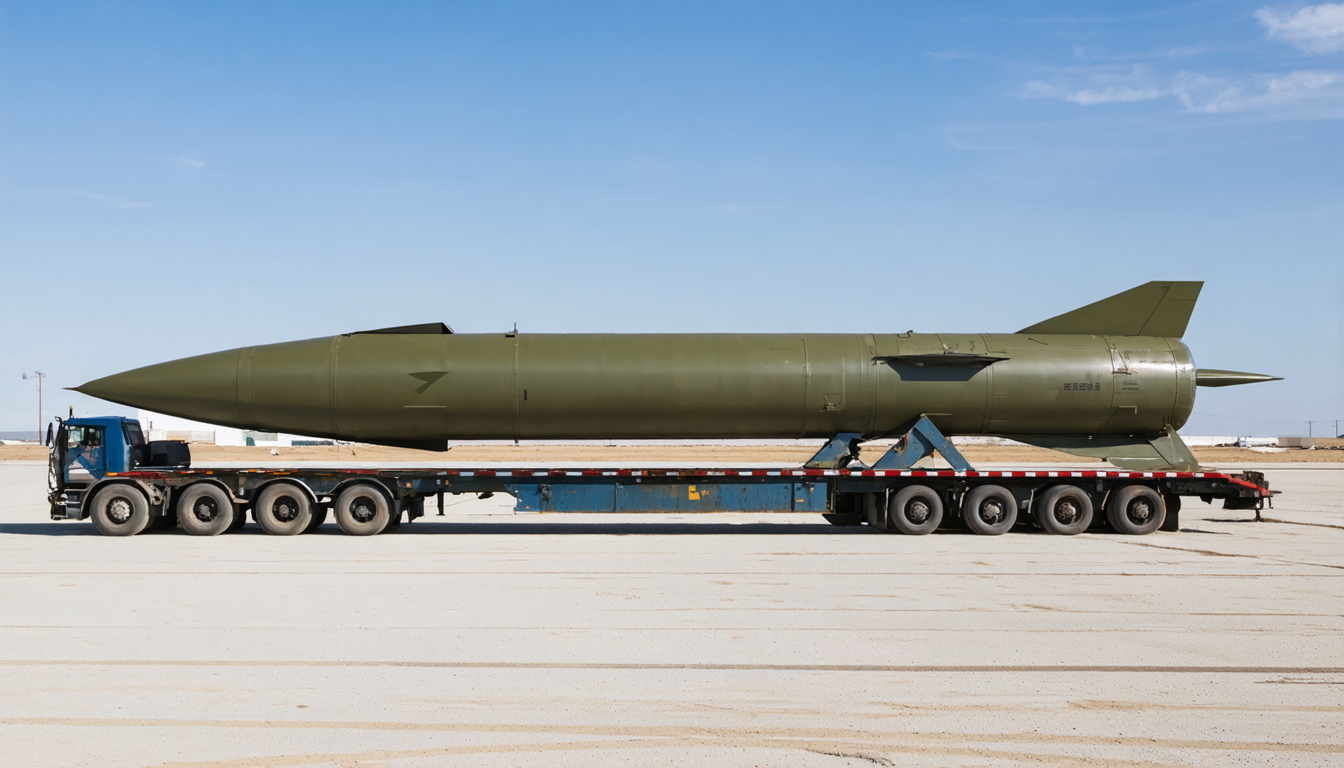
More than three years after its first deadline, the Army is still fielding Dark Eagle
The US Army says it has not yet declared its Dark Eagle hypersonic missile fully fielded, more than three years after the original target. A missile that flies in tests can still lack what a unit needs to use it.
The Product Desk
Original target 2023, slipped after flight-test setbacks. Moved to 2025, then into 2026. Program office: more training, sustainment and readiness work before full fielding. Latest update: no definitive completion date. Bloomberg: the delay has the US lagging China and Russia.
- What it sets up precedent Army's original schedule Called for the weapon to be available in 2023; that deadline slipped after flight-test setbacks, claim 5
- Who has to decide decision Army Moved its fielding target to 2025, then into 2026, claim 4
- What it limits constraint Army program office Must finish more training, sustainment and readiness work before declaring it fully fielded, claim 2
- What it limits constraint Army's latest update Does not provide a definitive completion date, claim 14
- Who's exposed exposure Bloomberg Describes the delay as one that has the US lagging China and Russia, claim 16
| Who | How | Kind | Claim |
|---|---|---|---|
| Army's original schedule | Called for the weapon to be available in 2023; that deadline slipped after flight-test setbacks | precedent | 5 |
| Army | Moved its fielding target to 2025, then into 2026 | decision | 4 |
| Army program office | Must finish more training, sustainment and readiness work before declaring it fully fielded | constraint | 2 |
| Army's latest update | Does not provide a definitive completion date | constraint | 14 |
| Bloomberg | Describes the delay as one that has the US lagging China and Russia | exposure | 16 |
What happened
- The Army's program office said it "continues fielding activities" but has more training, sustainment and operational-readiness work to finish first.
- The Army has already missed fielding targets in 2023 and 2025, and it had moved the goal into 2026.
- The Army activated a dedicated Dark Eagle battery in December 2025 and, with the Navy, launched the common missile from Cape Canaveral on March 26, 2026.
- In July, Bloomberg reported that Army officials had identified quality defects affecting missile deliveries.
Why it matters
- What it limits constraint A battery, a test launch and an exercise each prove one part of the system, so none can move the declaration on its own. The Army ties it to the remaining training, sustainment and readiness work.
- Who's exposed exposure With no completion date, the Army has nothing to say against Bloomberg's framing that the delay leaves the US behind China and Russia.
- Who has to decide decision Anyone shipping their own system has to write down what 'done' means before committing to a date, and accept that an honest definition gives a later date up front.
Next story · Invest · Oct 6
Anduril puts more of its own money into a submarine yard than its Navy contract is worthConfirmed13 publishers
The first unit to receive Dark Eagle hardware got it in 2021, and the equipment initially arrived without the live missiles needed to provide the complete capability [7]. The Army's original schedule had called for the weapon in 2023, and that date slipped after flight-test setbacks that included a canceled test [5].
A milestone list is what a program office reports. What a unit lives with is longer. Interesting Engineering, which reported the Army's statement, wrote that "Fielding requires more than a successful launch" and listed what else a unit needs: missiles, launchers, command-and-control equipment, trained personnel, maintenance support and the procedures to operate the system reliably [13].
Training shows the same gap. Soldiers trained with the system during Exercise Valiant Shield in June, according to National Defense magazine [9]. In the statement Bloomberg News reported on October 14, the Army still listed additional training among the work to finish [6][2].
Production runs through the reporting too. DefenseScoop reported in July that early flight-test complications contributed to a production bottleneck while contractors worked on manufacturing issues [11]. Interesting Engineering's point about the quality defects Bloomberg reported that month is that the weapon has to be manufactured consistently and supplied in sufficient numbers [15]. The Government Accountability Office's 2026 assessment found production and schedule challenges across several Pentagon hypersonic programs [12].
The Army did not give a completion date [14]. Bloomberg's account frames the delay as leaving the US lagging China and Russia [16].
We think the definition of "fully fielded" should be written before the date, and the cost is that an honest definition produces a later date on the first day. The check we'd use is a two-column list. Write each clause of the definition, then mark whether it has been shown in a test or exercise or is "routine." Set the date from the second column. On that sort, a March 2026 launch is a first-column item [8]. The training, sustainment and readiness work the Army still lists belongs in the second, and it has no date [2][14].
What to watch
- Whether the Army attaches a date to the full-fielding declaration; the October statement did not.
- Whether the Army or its contractors report the missile quality defects Bloomberg described in July as resolved.
- Whether the Army says its remaining training and sustainment work is done, since that is the condition it named for the declaration.
Clarity's read
What the record supports and how the coverage leans. The claims behind it follow.
Reality
- Evidence62
- Adoption35
- Hype gap+10
- Incentives
- Not scored
- Confidence65
Claim ledger
Ranked by verification strength, evidence, and original report placement.
- [1]
The Army said it still has not fully fielded the country's first hypersonic weapon, acknowledging a more than three-year delay in deploying the technology.
- [2]
The Army's program office said in a statement that it "continues fielding activities" for the Dark Eagle long-range hypersonic missile and must complete additional training and other sustainment and operational-readiness activities "before declaring the system fully fielded."
- [3]
The Army has already missed several previous deadlines to field the technology, including in 2023 and 2025.
- [4]
The service moved its fielding target to 2025, then into 2026.
- [5]
The Army's original fielding schedule called for the weapon to become available in 2023, and that deadline slipped after flight-test setbacks, including a canceled test expected to demonstrate progress toward operational use.
- [6]
The Army's statement was reported by Bloomberg News on October 14.
- [7]
The Army delivered prototype hardware to its first unit in 2021, but the equipment initially arrived without the live missiles needed to provide the complete capability.
- [8]
The Army activated a dedicated Dark Eagle battery in December 2025, and the Army and Navy conducted a successful launch of their common hypersonic missile from Cape Canaveral, Florida, on March 26, 2026.
- [9]
Soldiers trained with the system during Exercise Valiant Shield in June.
- [10]
In July, Bloomberg reported separately that Army officials identified quality defects affecting missile deliveries.
- [11]
In July, DefenseScoop reported that early flight-test complications contributed to a production bottleneck, while contractors worked to address manufacturing issues.
- [12]
The Government Accountability Office's 2026 assessment identified production and schedule challenges across several Pentagon hypersonic programs.
- [13]
Fielding requires more than a successful launch: units need missiles, launchers, command-and-control equipment, trained personnel, maintenance support, and the procedures needed to operate the system reliably.
- [14]
The Army's latest update does not provide a definitive completion date.
- [15]
Resolving the quality issues is important because the weapon must not merely demonstrate its performance during testing but also be manufactured consistently and supplied in sufficient numbers.
- [16]
Bloomberg's report describes the delay as one that has the US lagging China and Russia.
Sources
2 independent publishers whose own reporting we read for this story.
- interestingengineering.comUS Army’s 1,700-mile Dark Eagle hypersonic missile faces delays as China, Russia move ahead
1 article · October 15, 2026
- news.bgov.comUS Army Now Three Years Late Fielding Hypersonic Missile
1 article · October 14, 2026
Topics and entities
Entities
- Dark Eagle (Long-Range Hypersonic Weapon)
- Conventional Prompt Strike
- Government Accountability Office
- U.S. Army