Max Planck researchers say the 2024 Anthropocene vote broke the IUGS's own rules
Max Planck researchers argue in Earth's Future that most votes cast in the 12-to-4 rejection of an Anthropocene epoch were invalid under IUGS rules. They ask the geology union to publish the records behind the decision and open the process to an independent review.
The Scientist · Science desk
What happened
- The authors say the Anthropocene Working Group could not address reviewers' comments or make revisions to its proposal during the evaluation.
- An internal ethics report on the alleged violations was not acted on by the IUGS executive committee and remains publicly inaccessible, according to the authors.
- Adele Bertini, who co-chaired the voting subcommittee, maintains the process was fair and says she is open to scrutiny of the documents.
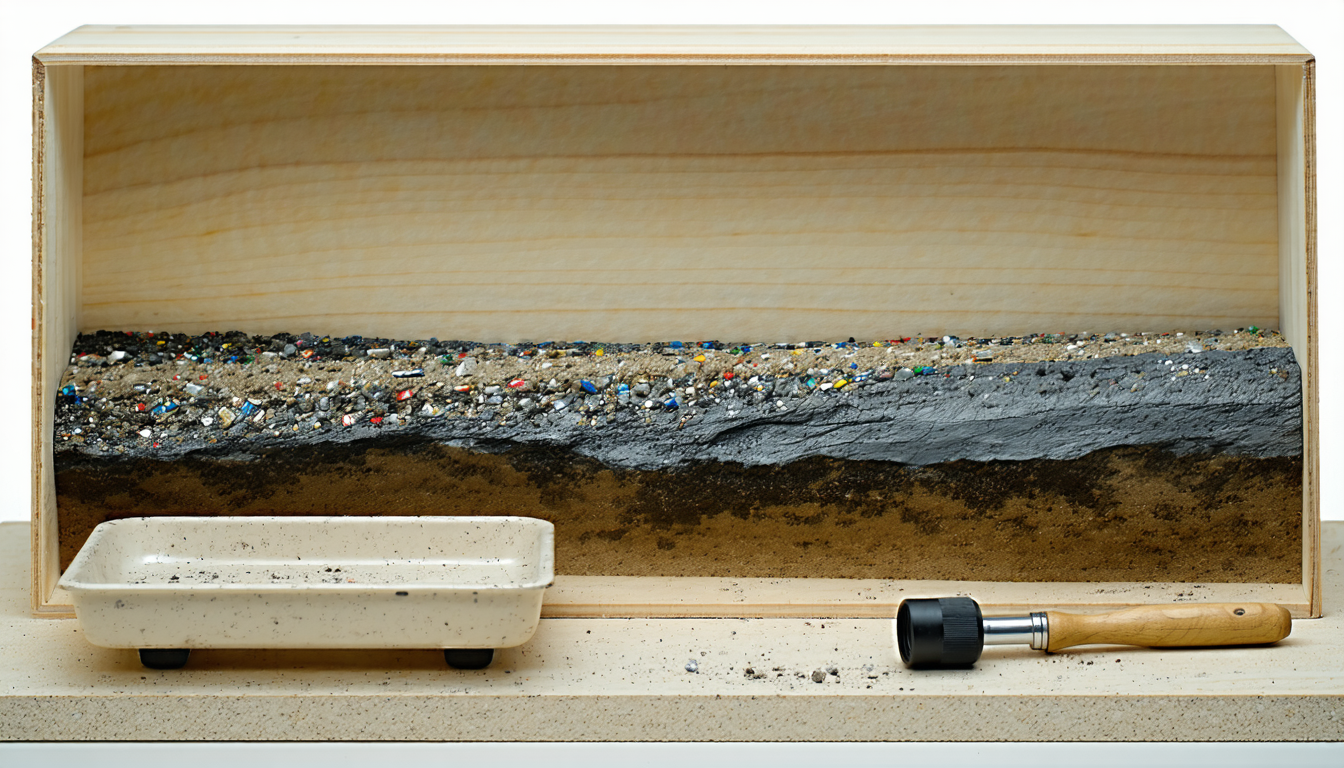
- The rejected proposal dated the Anthropocene's start to 1952, when plutonium from nuclear weapons tests appeared as a layer in Earth's strata.
Why it matters
- What doesn't add up contradiction Bertini points to a technical explanation she co-authored last month, against the paper's claim that no adequate justification ever appeared; much of the complaint depends on whether a journal comment counts as the IUGS's reasoning.
- Who has to decide decision IUGS leadership must now either release the vote records and ethics report or leave a published procedural charge unanswered against a decision it upheld in 2024.
- What it limits constraint The invalid-vote charge can only be tested once the documents the authors cite are released, so until then it is their reading of an unpublished record.
Next story · Science · Oct 4
East Antarctica's Wilkes Basin holds 3 to 4 meters of sea-level rise in ice too poorly observed to forecastConfirmed2 publishers
The paper's lead author, Georg Schäfer, describes the charge as one about process. "Our main concern isn't the rejection itself. A proposal can legitimately be rejected," he said. "The issue is that no adequate scientific justification for it was ever published, and serious allegations of procedural inconsistencies remain unaddressed." [19]
The first thing to check is the count. Eighteen subcommittee members took part in the 2024 vote: 12 voted to reject, 4 to accept and 2 abstained [6][17]. Rejection carried 75% of the yes-or-no votes [18]. The authors say a majority of the votes cast were invalid under the body's rules [20]. Counting only the 16 votes for or against, a majority is at least nine ballots. Only four supported the proposal, so at least five of the invalid ones would have to be votes to reject [16]. An invalid ballot is a defect of procedure. It does not by itself say how that member would have voted under the correct procedure. The reporting does not say which ballots the authors consider invalid, or on what grounds.
Jürgen Renn, founding director of the Max Planck Institute of Geoanthropology and a co-author, put the case in public terms. "If decisions regarding a humanity-induced planetary crisis can be made behind closed doors, with key documents withheld and public communication vague or contradictory, then geoscience's capacity to inform societal understanding of Earth system change is diminished," he said [2]. He told Nature: "It was such a historical decision." [3] The authors want an independent review to maintain "public trust in our capacity to understand and respond to planetary transformation" [4].
None of this settles the geology. Formally, the planet is in the Holocene, which began 11,700 years ago at the end of the last glacial period [11]. The Anthropocene Working Group started gathering evidence for a new epoch in 2009 [12]. Its proposed 1952 plutonium marker lined up with a spike in atmospheric carbon dioxide and methane [10]. "The case for the Anthropocene remains strong," said Jan Zalasiewicz, a University of Leicester geologist who led much of the group's work [13].
Phil Gibbard of the University of Cambridge voted to reject. "I was born in 1949, and I don't remember seeing any geological boundaries during that period," he said [14]. He and others have since argued for calling the Anthropocene an "event", the category geologists use for episodes such as the Great Oxidation Event, when oxygen first built up in Earth's atmosphere [15].
What to watch
- Whether the IUGS executive committee publishes the internal ethics report and the subcommittee ballots, or replies to the paper formally.
- Whether released records show which votes the authors count as invalid and on what grounds, and whether at least five of the 12 rejections are among them.
- Whether any body commissions the independent procedural review the authors request, and who conducts it.
Clarity's read
What the record supports and how the coverage leans. The claims behind it follow.
Reality
- Evidence40
- Adoption
- Not scored
- Hype gap+20
- Incentives55
- Confidence55
Claim ledger
Ranked by verification strength, evidence, and original report placement.
- [1]
A commentary paper in Earth's Future by authors from the Max Planck Institute of Geoanthropology calls on the IUGS to fully disclose the relevant documentation and calls for an independent procedural review of the decision to reject the Anthropocene epoch.
- [2]
"If decisions regarding a humanity-induced planetary crisis can be made behind closed doors, with key documents withheld and public communication vague or contradictory, then geoscience's capacity to inform societal understanding of Earth system change is diminished," says Jürgen Renn, founding director of the Max Planck Institute of Geoanthropology.
- [3]
"It was such a historical decision," says Jürgen Renn, who co-authored the Earth's Future paper.
- [4]
Renn and his co-authors call for an independent review of the process to maintain "public trust in our capacity to understand and respond to planetary transformation".
- [5]
In 2024 the IUGS upheld a decision to reject the proposal to establish the Anthropocene as a new epoch.
- [6]
When the proposal was put to the vote in 2024 before a subcommittee of stratigraphers, it was rejected 12 to 4, with two members abstaining.
- [7]
Adele Bertini, a University of Florence geologist who co-chaired the voting subcommittee, maintains the process was fair and says she is open to scrutiny of the documents.
- [8]
Bertini co-authored a comment in Nature Reviews Earth & Environment last month giving a technical explanation for the proposal's rejection.
- [9]
The proposal would have established the Anthropocene as starting in 1952, when a layer of plutonium from nuclear weapons testing appeared in Earth's strata.
- [10]
The 1952 plutonium marker correlated with other human-driven shifts, including a spike in the concentration of carbon dioxide and methane in the atmosphere.
- [11]
The planet is currently in the Holocene epoch, which started 11,700 years ago with the end of the last glacial period.
- [12]
In 2009 the Anthropocene Working Group began gathering evidence that human industrialization has initiated a new epoch.
- [13]
"The case for the Anthropocene remains strong," says Jan Zalasiewicz, a geologist at the University of Leicester who led much of the working group's efforts.
- [14]
"I was born in 1949, and I don't remember seeing any geological boundaries during that period," says Phil Gibbard, a University of Cambridge geologist who voted to reject the proposal.
- [15]
Gibbard and others have argued for referring to the Anthropocene as an 'event' rather than an epoch; geological events include episodes such as the Great Oxidation Event, when Earth's atmosphere first filled with high concentrations of oxygen.
- [16]
If a majority of the 16 for-or-against votes were invalid, at least nine ballots are invalid, and at least five of them must be votes to reject.
- [17]
Eighteen subcommittee members took part in the 2024 vote, counting abstentions.
- [18]
Rejection carried 75% of the yes-or-no votes.
- [19]
"Our main concern isn't the rejection itself. A proposal can legitimately be rejected," says Georg Schäfer, lead author of the paper. "The issue is that no adequate scientific justification for it was ever published, and serious allegations of procedural inconsistencies remain unaddressed."
- [20]
The authors say the voting process was invalid, in that the majority of votes cast were invalid under the body's rules.
- [21]
Some scholars say there are unpublished documents showing that the proposal's rejection was illegitimate and that the rationale for the decision was never adequately explained.
- [22]
The authors describe a compromised evaluation in which the Anthropocene Working Group could not address comments or make revisions.
- [23]
An internal ethics report investigating the alleged violations, which the IUGS executive committee did not act upon, remains publicly inaccessible.
Sources
2 independent publishers whose own reporting we read for this story.
- nature.comBattle of the Anthropocene: allegations re-ignite row over proposed geologic epoch
1 article · September 30, 2026
- phys.orgScience or strategy? Researchers call for transparency over the Anthropocene rejection
1 article · October 1, 2026
Topics and entities
Topics
- Stratigraphy and the geologic time scale
- Scientific governance
Entities
- International Union of Geological Sciences
- Nature Reviews Earth & Environment
- Anthropocene Working Group
- Earth's Future
- Max Planck Institute of Geoanthropology