Positron's second tranche pays a 16 per cent step-up inside the same announcement
The $375m Series C priced Positron at $3.5bn before the money, and the up-to-$500m follow-on has to be sitting at $4.5bn pre-money to reach the $5bn headline, which only holds if every dollar of it is drawn.
The Investor · Invest desk
What happened
- Positron AI announced an $875m Series C on 10 September 2026 at a $5bn post-money valuation, raised in two tranches from a syndicate co-led by NEA, Atreides, Valor, Andra and SemiAnalysis Capital.
- The company's previous round was $230m in February at a $1bn valuation, according to the Wall Street Journal, making the new mark five times higher.
- Forest Baskett of NEA, Gavin Baker of Atreides, Thomas Jermoluk of Jim Clark Office and analyst Dylan Patel all join the Positron board as part of the financing.
Why it matters
- What it limits constraint Committing the proceeds to LPDDR5X supply and a 2027 tapeout means Positron is not bidding for HBM or advanced packaging allocation, so its 2027 cost curve is set by commodity memory pricing rather than by the packaging queue.
- Who's exposed exposure With no revenue disclosed, roughly $100m of the valuation sits behind each Atlas rack in the field, which places the risk on a chip that has not yet taped out rather than on the installed base.
- What doesn't add up contradiction Positron quantifies bandwidth as a percentage realised rather than in GB/s, so a buyer cannot compare its commodity-memory node against an HBM part using anything the company has published.
- What it sets up precedent A benchmarking firm co-leading the tranche and taking a board seat normalises equity ties between the people who measure inference economics and the vendors whose economics they measure.
Next story · Product · Oct 2
Nvidia and Intel Capital back CScale's $188 million bid for optics that survive laser failuresConfirmed3 publishers
Two prices sit inside one announcement. The first tranche, $375m, went in at $3.5bn before the money [2], which puts $3.875bn on the company the moment it closes [17]; the follow-on Series C-1 of up to $500m has to be priced at $4.5bn pre-money to arrive at the $5bn post-money figure in the headline [1][3][18], a step-up of about 16 per cent for cheques written into the same press release [19]. NEA leads both [2][3], so the structure reads less like two negotiations than one schedule with a break clause, and the words "up to" are doing real work: if the second tranche comes in short, $5bn was never a price anybody paid [3].
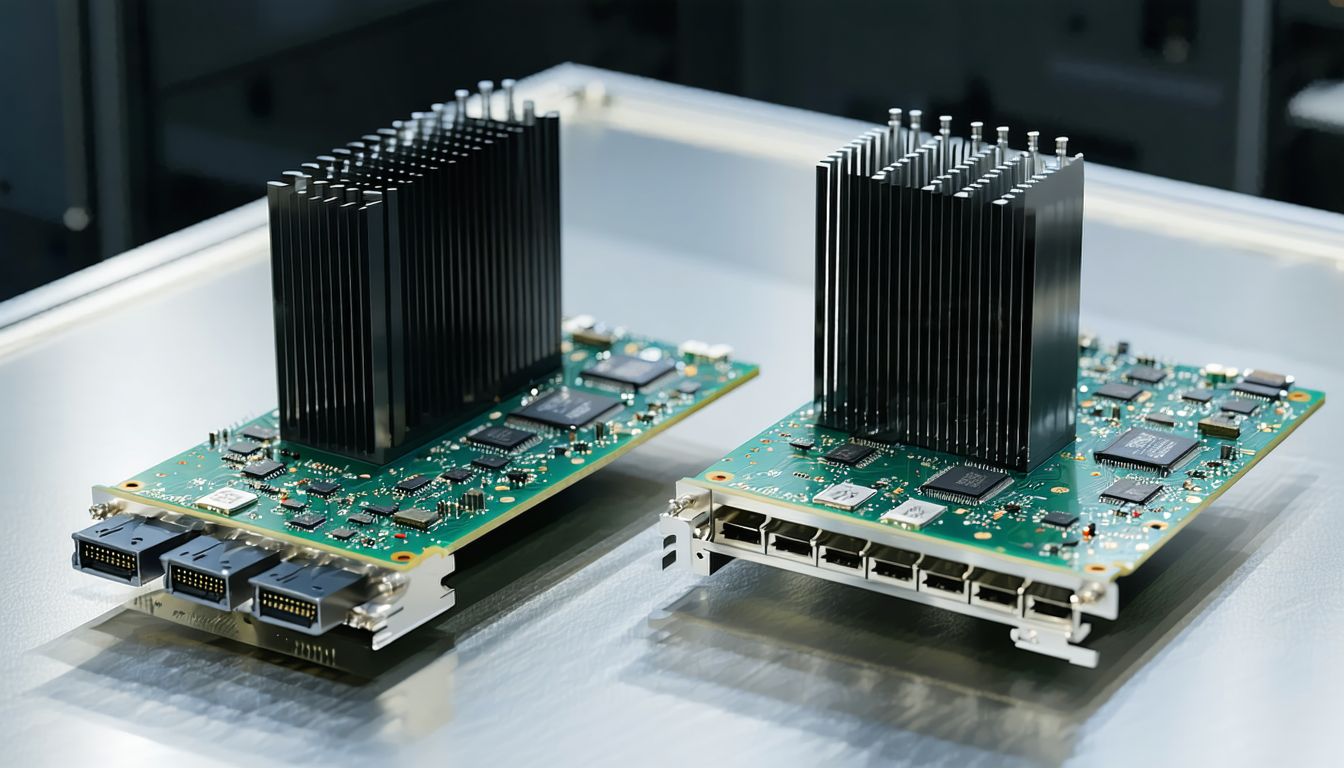
What the $5bn is priced against is the more interesting question, because neither account discloses revenue [16]. The physical evidence is more than 50 racks of first-generation Atlas at Oracle Cloud Infrastructure, with Parasail running its own inference service on that capacity and Jump Trading and i3d.net named as production customers [7]. Divide the valuation by the deployed racks and the market is paying $100m per rack in the field [20], which is another way of saying the price is on Asimov, the chip that tapes out on TSMC N3P at the end of 2026 and reaches production in the second half of 2027 [5]. Roughly a year of spending before the thing being valued sells anything [13].
The memory arithmetic is where the design argument becomes checkable. Asimov carries between 288GB and 2,304GB per chip [5], and Titan puts four to eight of them in a node aimed at models beyond 16 trillion parameters and context windows beyond 10 million tokens [10]; eight chips at the top of that range is 18.4TB [21], and a 16-trillion-parameter model at one byte per weight is 16TB, which leaves about 2.4TB for cache and activations [22]. The claim closes. It closes only at the top memory configuration, and only at roughly a byte per parameter.
Against that, the disclosure has a hole where the comparison should be. Positron says its next-generation systems realise more than 90 per cent of available memory bandwidth [23], which is a utilisation figure and not a bandwidth figure, and 90 per cent of commodity LPDDR5X [9] cannot be set against a worse fraction of HBM without a GB/s number that has not been published. Dylan Patel, whose SemiAnalysis Capital co-led the first tranche and who now takes a board seat [2][4], says most inference economics struggle when measured in production [14]. The measurement everyone will want next is of the company he has funded.
There are readings where this looks cheap. If capacity per dollar is what long-context serving actually pays for [24], a node holding 18.4TB [21] on memory nobody is queuing for [9] sells itself; if HBM and packaging supply loosens before the second half of 2027 [5], the sidestep is worth less than $5bn implies; if the tapeout slips past December, the window closes on its own. The cash supports the first reading more than the narrative does, in this sense: the money funds a tapeout, a 2MW-plus engineering data centre and LPDDR5X supply commitments [6], not a sales ramp, and $1.1bn of disclosed equity in seven months [15] is what buying commodity memory volume up front costs when the alternative is standing in the HBM line.
What to watch
- Whether Asimov tapes out on TSMC N3P by the end of 2026, and whether the full $500m of the C-1 is actually drawn.
- Named Titan customers beyond the three Atlas references, or an Oracle deployment that goes past 50 racks.
- Any third-party GB/s or tokens-per-dollar measurement of Titan once the silicon is in production.
Information, not investment advice. This story is general information about companies and markets, drawn from cited reporting. It is not a recommendation to buy, sell or hold any security; check the cited sources before acting.
Clarity's read
What the record supports and how the coverage leans. The claims behind it follow.
Reality
- Evidence55
- Adoption30
- Hype gap+35
- Incentives70
- Confidence60
Perspective Coverage
4 publishers- Builder
- Builder 34%
- Operator
- Operator 21%
- Investor
- Investor 45%
Claim ledger
Ranked by verification strength, evidence, and original report placement.
- [1]
Positron AI, based in Reno, Nevada, announced on 10 September 2026 an $875m Series C financing at a $5bn post-money valuation.
- [2]
The Series C tranche was $375m priced at a $3.5bn pre-money valuation, co-led by NEA, Andra Capital, Atreides Management, Valor Equity Partners and Dylan Patel's SemiAnalysis Capital.
- [3]
The Series C-1 tranche, of up to $500m, was led by NEA and Jim Clark, founder of Silicon Graphics and Netscape.
- [4]
Forest Baskett of NEA, Gavin Baker of Atreides Management, Thomas Jermoluk from Jim Clark Office and Dylan Patel join Positron's board of directors as part of the financing.
- [5]
Asimov tapes out on TSMC N3P at the end of 2026, with production in the second half of 2027, and pairs Positron's compute architecture with 288 GB to 2,304 GB of memory per chip.
- [6]
The financing will fully fund the Asimov tapeout, the bring-up of a 2 MW-plus engineering data centre and emulation platform, and the Titan production ramp including LPDDR5X supply commitments, production capacity, system integration and go-to-market expansion.
- [7]
Positron is deploying more than 50 racks of Atlas, its first-generation inference system, at Oracle Cloud Infrastructure; partner Parasail uses that capacity to power its own inference service, and additional Atlas production customers include Jump Trading and i3d.net.
- [8]
Additional investors include DFJ Growth, Qatar Investment Authority, Resilience Reserve, Arena Private Wealth, Natural Capital, Helena, 1517 Fund, Flume Ventures, Unless, Boardman Bay Capital Management, Fincadia Advisors, Banyan Ventures and U First Capital, alongside strategic investors VentureTech Alliance, Hudson River Trading, Cisco Investments and Naver Ventures.
- [9]
Positron's next-generation systems are built on commodity LPDDR5X memory that sidesteps constrained HBM and CoWoS supply chains.
- [10]
Titan combines four to eight Asimov chips into a single system designed to serve models beyond 16 trillion parameters and context windows beyond 10 million tokens in a single node, scaling to thousands of nodes.
- [11]
CEO Mitesh Agrawal said the focus now is to tape out Asimov, bring Titan to production, and scale manufacturing to meet demand, and that deploying Atlas at Oracle informed the design of both.
- [12]
Positron's prior round was a $230m raise in February that valued the company at $1bn, according to the Wall Street Journal; the new round values it five times higher.
- [13]
Asimov production in the second half of 2027 is roughly a year after the September 2026 financing.
- [14]
Dylan Patel, founder and CEO of SemiAnalysis Capital, said: "We spend our lives measuring what AI hardware actually delivers in production, and most inference economics struggle under that scrutiny," adding that Positron addresses memory without depending on HBM or advanced packaging for its next-generation systems.
- [15]
Positron has disclosed about $1.1bn of equity raised across seven months, counting February's $230m and September's $875m.
- [16]
Neither the company announcement nor the Yahoo Finance report states a revenue, bookings or backlog figure for Positron.
- [17]
A $375m tranche at a $3.5bn pre-money valuation implies a post-money valuation of $3.875bn for that tranche.
- [18]
For the round to reach a $5bn post-money valuation with the full $500m Series C-1 drawn, the C-1 must be priced at $4.5bn pre-money.
- [19]
The implied C-1 pre-money of $4.5bn is about 16 per cent above the $3.875bn post-money of the $375m Series C tranche.
- [20]
A $5bn valuation against more than 50 deployed Atlas racks is about $100m of valuation per rack in the field.
- [21]
Eight Asimov chips at the top of the stated memory range give 18,432 GB, or about 18.4 TB, of memory in a single Titan node.
- [22]
A 16-trillion-parameter model at one byte per weight occupies 16 TB, leaving roughly 2.4 TB of an 18.4 TB Titan node for cache and activations.
- [23]
Positron says its next-generation systems realise more than 90 per cent of their available memory bandwidth and deliver leading tokens per dollar and tokens per watt.
- [24]
Positron says AI's centre of gravity is shifting from training models to running them, and that serving inference demand at scale is increasingly constrained by memory capacity, memory bandwidth and power.
Sources
4 independent publishers whose own reporting we read for this story.
- finance.yahoo.comPositron AI raises $875 million Series C at $5 billion valuation
1 article · September 10, 2026
- prnewswire.comPositron AI Raises $875 Million at a $5 Billion Valuation to Bring Its Next-Generation Inference Silicon to Market
1 article · September 10, 2026
- ventureburn.comPositron AI Raises $875M to scale memory-first inference hardware
1 article · September 10, 2026
- verdict.co.ukAI inference startup Positron raises $875m at $5bn valuation
1 article · September 11, 2026
Topics and entities
Topics
- Venture Capital Funding
- AI inference hardware
- AI Memory Supply Chain