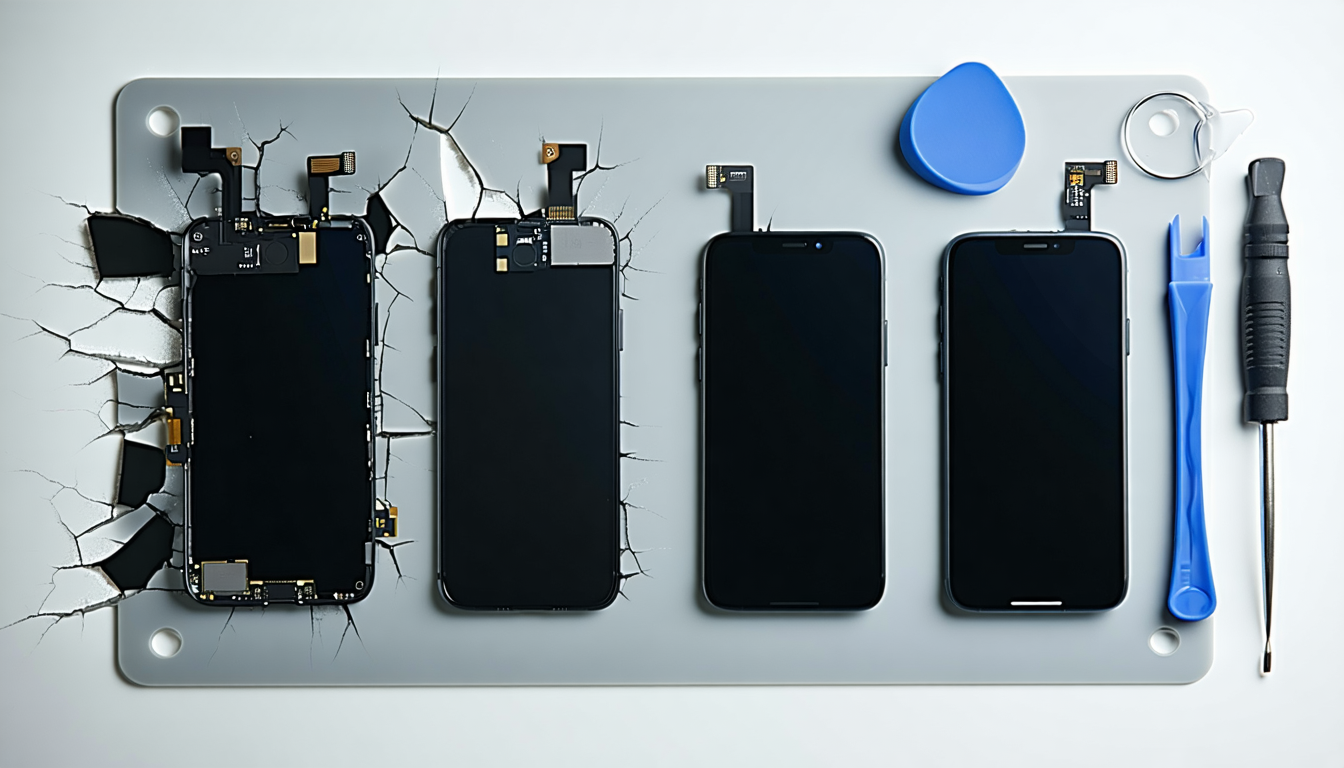
Three of four iPhone 18 Pros tore a plastic screen frame when iFixit opened them
iFixit's teardown of the iPhone 18 Pro and Pro Max finds real precision in the new magnet-driven aperture and a service path that ends in whole-assembly replacement, plus screen frames that tore on the way in.
The Engineer · Build desk
What happened
- The plastic frame around the screen tore apart on three of the four iPhone 18 Pro and Pro Max units iFixit opened for its teardown.
- iFixit reports the system-on-chip now sits outside the logic board for better cooling, alongside a much larger cooling system and a screwed-in battery tray.
- The new main camera fits six overlapping polymer composite leaf blades into the same footprint as last year's camera, and magnetism moves them open and closed.
- iFixit says very few repair enthusiasts anywhere have the tools, techniques or knowledge to get the aperture mechanism apart in a way that lets it go back together.
- Apple leaned on the main camera in its Hollywood-themed keynote, which iFixit notes was shot entirely on an iPhone 18 Pro.
Why it matters
- What it costs cost The fix for one stuck blade is a whole new camera assembly, so the owner's bill tracks Apple's part price.
- What it limits constraint Tight tolerances and gummy adhesive put the aperture beyond what a well-equipped independent bench can reopen, leaving third-party camera work to module swaps.
- Who's exposed exposure Anyone opening this phone for a battery or screen job risks adding a torn frame to the job, and the three tears happened to technicians who do this professionally.
- What it sets up precedent Stuck apertures reported by Galaxy owners and oil creeping onto blades are known failures of this class of mechanism, so iPhone service queues can expect them too.
Next story · Leadership · Oct 5
Apple's iPhone 18 Pro costs £100 more than last year's modelConfirmed2 publishers
Each blade pivots on its outermost round hole, slides along a pin in the middle slot, and catches on a notch cut into its edge [12]. All six have to move past one another without snagging [12]. The blades are about as thin as a human hair under iFixit's Evident DSX2000 microscope [11]. Magnets do the driving, and iFixit opened and closed the aperture by holding a magnet near it after stripping the supporting hardware away [10]. Six blades keep the opening almost perfectly round, minor imperfections show up as a starburst, and more blades would give a smoother circle [14].
Getting in took heat and prying, then more heat and prying, until the lens cover popped off and the blades flew across the teardown room [4]. The tolerances are tight and the glues are gummy [5]. iFixit said it is reluctant to call any repair impossible, but that this one comes about as close as it gets [5]. Damage to the main camera therefore means a new assembly [6].
Three of four is 75 percent of the units opened [20], and the sample is four phones, taken apart by people who take phones apart for a living [1]. iFixit set the tearing aside with "More on that later," and the portion of the teardown published so far does not attribute it to the relocated chip or the bigger cooling system [13]. For that rate to transfer to a repair bench, the cause has to sit in the frame and its adhesive. If it is technique, or one bad batch of frames, four units will not tell you which.
Variable aperture in a phone is old news. Nokia shipped it in the N86 in 2009, Samsung in the Galaxy S9 in 2018, and it has appeared in more recent Huawei and Xiaomi models, which is why iFixit writes that "Apple's a little late to the game" [15]. The shop dates the overlapping-blade diaphragm to an 1858 patent by Harrison and Schnitzer, the same year John Mason patented the jars in your grandma's pantry [16].
As a reason to buy, iFixit is blunt: the variable aperture is unlikely to be worth an upgrade, and the photo quality difference from other recent iPhones is small enough that most people probably will not notice [18]. "The most sustainable phone is the one already in your pocket," the teardown says [19].
What to watch
- Whether independent shops report the same screen-frame tearing once iPhone 18 Pro display swaps reach volume.
- What Apple charges for a main camera assembly out of warranty, and whether the part reaches independent repairers.
- Whether stuck-aperture complaints appear on the iPhone 18 Pro the way iFixit says they did on Galaxy units.
Clarity's read
What the record supports and how the coverage leans. The claims behind it follow.
Reality
- Evidence72
- Adoption
- Not scored
- Hype gap+10
- Incentives
- Not scored
- Confidence66
Claim ledger
Ranked by verification strength, evidence, and original report placement.
- [1]
iFixit wrote that the screen's plastic frame tore apart on three of the four iPhone 18 Pro phones it opened.
- [2]
iFixit's teardown reports that the iPhone 18 Pro's SoC now sits outside the logic board for better cooling.
- [3]
iFixit found a screwed-in battery tray and a much larger cooling system inside the iPhone 18 Pro and Pro Max.
- [4]
iFixit pulled the phone apart, yanked the main camera out, and heated and pried repeatedly until the lens cover popped off and aperture blades flew across the teardown room.
- [5]
iFixit wrote: "The tolerances are tight, the glues are gummy. We're reluctant to call a repair 'impossible,' but this is about as close as it gets."
- [6]
iFixit wrote that any damage to the main camera will probably mean replacing the whole assembly.
- [7]
iFixit wrote that very few repair enthusiasts on the planet will have the tools, techniques, or knowledge to get the variable aperture mechanism apart in a way that allows it to go back together.
- [8]
iFixit describes the variable aperture as thoughtfully designed but hard to repair.
- [9]
The mechanism packs six tiny overlapping "polymer composite" leaf-like blades into the same main camera footprint as last year.
- [10]
Magnetism drives the movement; iFixit triggered the actuation by putting a magnet near the aperture, and it opened and closed even with supporting hardware removed.
- [11]
Each aperture blade is about as thin as a human hair, as seen under iFixit's Evident DSX2000 microscope.
- [12]
All six blades have to move past one another without snagging; a blade pivots on the outermost round hole, slides along a pin in the middle slot, and catches back on the notch on the edge of the blade.
- [13]
iFixit followed the note about the torn frames with "More on that later," and the published portion of the teardown does not attribute the tearing to the relocated SoC or the larger cooling system.
- [14]
The shape and movement of the blades keep the opening almost completely round, minor imperfections can cause a noticeable starburst effect, more blades mean a smoother circle, and Apple settled on six.
- [15]
Variable aperture appeared in Nokia's N86 in 2009 and Samsung's Galaxy S9 in 2018, and in more recent Huawei and Xiaomi models; iFixit wrote "Apple's a little late to the game."
- [16]
iFixit wrote that two men named Harrison and Schnitzer patented an overlapping-blade photographic diaphragm in 1858, the same year John Mason patented the jars in your grandma's pantry.
- [17]
Apple leaned hard on the capabilities of the main camera in its Hollywood-themed keynote, which was shot entirely on an iPhone 18 Pro, according to iFixit.
- [18]
iFixit wrote that the variable aperture is unlikely to be worth an upgrade and that photo quality differences from other recent-model iPhones are small enough that most people probably won't notice.
- [19]
iFixit wrote: "The most sustainable phone is the one already in your pocket."
- [20]
The frame tore on 75 percent of the four units iFixit opened.
- [21]
iFixit wrote that some Galaxy users have reported stuck apertures and that camera repairers know oil migrating onto aperture blades can cause trouble, with more moving parts meaning more failure risk.
Sources
2 independent publishers whose own reporting we read for this story.
- iPhone 18 Pro teardown: its SoC now sits outside the logic board for better cooling, the variable aperture is thoughtfully designed but hard to repair, and more
ifixit.com
1 article · September 21, 2026
- techspot.comiPhone 18 Pro teardown highlights mechanical camera aperture and a major thermal redesign | TechSpot
1 article · September 21, 2026
Topics and entities
Topics
- Smartphone camera hardware
- Smartphone repairability
- Device teardowns