Engineered marine bacteria weather olivine 2.6 times faster in a seawater tank
A pilot bioreactor running on unprocessed seawater and acetate pulled 0.50 grams of CO2 a day out of the air from 4 kilograms of rock, a modest number obtained by direct measurement in a tank rather than by inference from a field plot.
The Scientist · Science desk
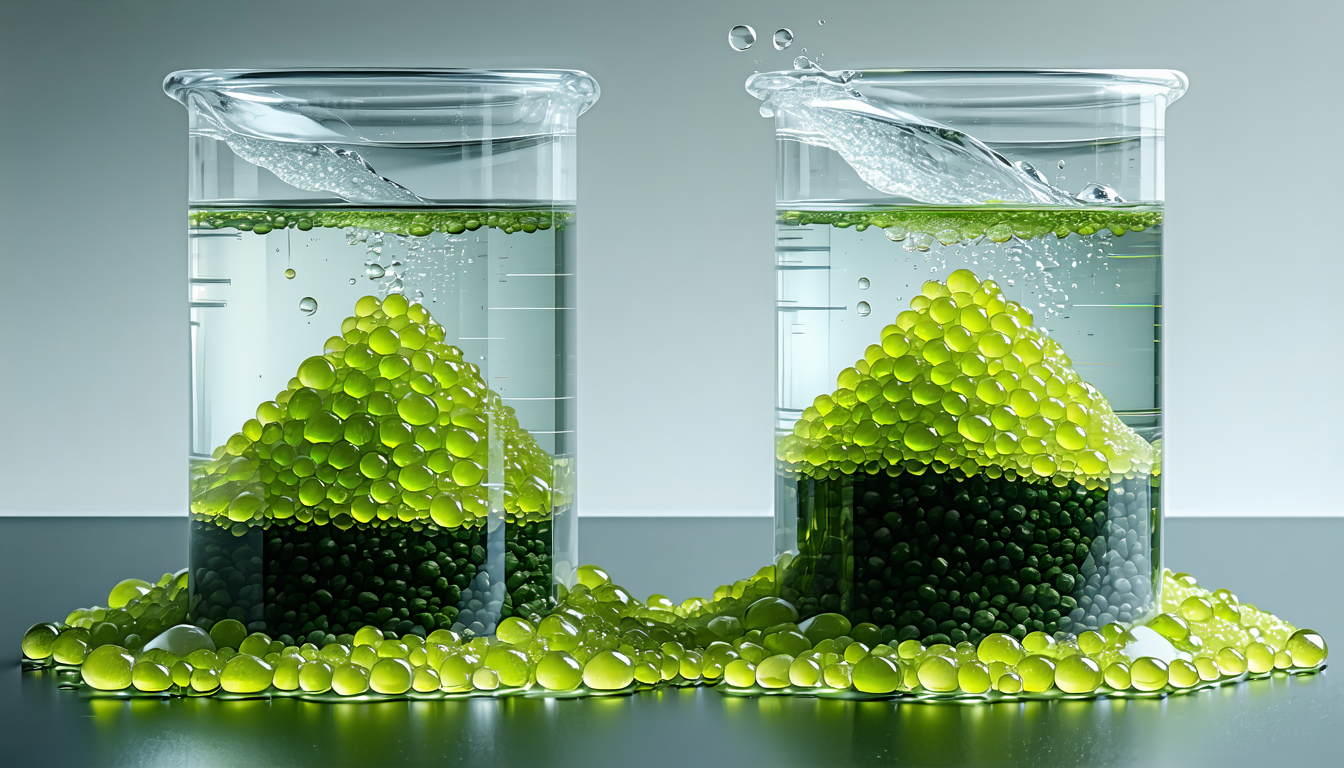
What happened
- The team found that bacteria in mineral bioreactors stop making siderophores under natural genetic control, which rules out continuous biological acceleration of weathering at scale.
- Engineering the marine bacterium Alteromonas macleodii for enhanced siderophore production raised the rate of olivine dissolution by a factor of 2.6.
- Pilot-scale continuous reactors were then built to run on unprocessed seawater and a renewable acetate feedstock while weathering a 4 kilogram charge of olivine.
- In the reactors containing engineered cells, the authors directly measured 0.50 grams of CO2 per day removed from the air via alkalinity generation.
Why it matters
- What's now possible capability Putting the reaction in a tank with controlled hydrology and known mineral surface area supplies the one thing spreading rock on soils and coastlines has struggled to deliver: a removal number you can meter rather than model.
- What it limits constraint Because net removal depends on renewable feedstock and low cell replenishment, a plant like this is sited by its acetate and power supply as much as by access to rock or seawater.
- Who has to decide decision At the demonstrated rate, buying removal from this route means buying a fleet count, so procurement diligence lands on how much tank a supplier can build and feed rather than on the biology.
- Who's exposed exposure Anyone quoting the 2.6-fold gain as a carbon figure is exposed on a substitution the paper does not make, since the rate ratio and the measured grams per day describe different quantities.
Next story · Science · 2d ago
Dedicated methane satellites caught 92% to 100% of test plumes in a controlled Arizona trialConfirmed2 publishers
Olivine armours itself. As iron leaves the mineral in wet, oxidising conditions, iron oxides precipitate back onto the surface and shut down further dissolution [9]. Siderophores are the counter: secreted molecules that chelate and solubilise ferric iron, and the siderophore desferrioxamine had already been shown in batch reactions to speed olivine dissolution by dissolving those passivating oxides [2][10].
The obstacle to running that trick continuously was genetic. In *Alteromonas macleodii*, the genes for the siderophore petrobactin switch on in response to iron limitation, as they do in most siderophore producers [4]. A tank packed with olivine is not iron-limited, so the bacteria stop making the useful molecule at the moment the process most needs it, and the authors confirmed experimentally that this natural regulation rules out continuous production in mineral bioreactors [3]. That is why the answer was a rewired strain rather than a better culture protocol [5].
The reactor format matters as much as the strain. Olivine dissolution generates alkalinity that is mostly stable bicarbonate drawn from atmospheric CO2 [12], which is precisely why the usual industrial way of dissolving minerals is unavailable here: chemical or biological acid leaching precludes alkalinity generation [15]. And in field trials that spread mafic rock on soils or coastlines, removal has been hard to quantify because the weathering is slow [11]. A tank fixes hydrology and mineral surface area, which is what makes the carbon accounting tractable [14].
Here is the arithmetic. At 0.50 g of CO2 per day [8], one of these reactors removes about 183 g in a year [18]. Reaching one tonne per year at that rate takes roughly 5,500 reactors of the same size [19]. Per kilogram of the 4 kg mineral charge, the measured rate is 0.125 g of CO2 per day [20]. So the scaling unit is reactor volume and mineral surface area, and this result describes a measured, engineered rate in a metered format, distinct from a delivered tonne of CO2 removed.
The reported figures leave two things unstated. The abstract gives a 2.6-fold ratio for dissolution rate and an absolute 0.50 g per day for the engineered reactors, so the CO2 removal ratio between engineered and unmodified cells is not stated [17]. And neither quantity is a cost per tonne [16]. The life-cycle analysis points at where that cost will live: renewable feedstock and minimal replenishment of the modified cells are the conditions for net removal at scale [6]. The strain work is the part that has been demonstrated; the acetate supply chain is the part that decides whether the ledger closes. Seawater is the cheap term, since it is abundant and can be returned to the environment carrying alkaline ions [13], and the authors are explicit that silicate weathering on its own is too slow for industrial deployment [1].
What to watch
- An independent replication of the 2.6-fold dissolution gain with a different olivine grain size, reporting the unmodified-cell control in absolute terms.
- Where the renewable acetate comes from at scale, and a published energy and cost figure per tonne to test the life-cycle analysis's conditions.
- Whether carbon registries will accept tank-metered alkalinity as verified removal, and require proof the returned seawater's bicarbonate persists.
Clarity's read
What the record supports and how the coverage leans. The claims behind it follow.
Reality
- Evidence74
- Adoption8
- Hype gap+28
- Incentives55
- Confidence68
Claim ledger
Ranked by verification strength, evidence, and original report placement.
- [1]
Silicate mineral weathering (dissolution) is described as a scalable strategy for capture and storage of CO2 but too slow for industrial deployment.
- [2]
Bacteria can accelerate mineral dissolution by secreting siderophores, secreted secondary metabolites that chelate and solubilise ferric iron released from the mineral.
- [3]
The authors demonstrate that natural genetic regulation precludes continuous siderophore production in mineral bioreactors, and confirmed experimentally that siderophore production is limited at scale.
- [4]
Alteromonas macleodii naturally produces the siderophore petrobactin, and the genes for petrobactin synthesis were previously shown to be expressed in response to iron limitation, as is typical for most siderophore-producing bacteria.
- [5]
The authors engineered the marine bacterium Alteromonas macleodii for enhanced siderophore production, conferring a 2.6-fold increase in the rate of olivine dissolution.
- [6]
Life-cycle analysis indicated that renewable feedstocks and minimal replenishment of modified cells are critical to achieve net CO2 removal at scale.
- [7]
The authors constructed pilot-scale continuous mineral bioreactors that use unprocessed seawater and a renewable acetate feedstock to weather 4 kg of olivine.
- [8]
In reactors with engineered cells, the authors directly measured removal of 0.50 g CO2 per day from the air through alkalinity generation.
- [9]
During natural weathering, iron oxides precipitate back onto the mineral surface and prevent further mineral dissolution; iron is abundant in mafic and ultramafic rocks and forms iron oxides in aqueous, oxidative conditions.
- [10]
In batch reactions, the siderophore desferrioxamine accelerated the dissolution of olivine by solubilisation of passivating iron oxides, and it was suggested that siderophore production may be limited by the presence of olivine.
- [11]
In ongoing field trials in which mafic rocks were distributed into soils or coastal environments, the extent of CO2 removal has been challenging to measure because of slow rock weathering rates.
- [12]
Mafic and ultramafic minerals such as olivine generate alkalinity upon dissolution; in marine and terrestrial media that alkalinity is primarily stable bicarbonate ions derived from atmospheric CO2.
- [13]
The authors reasoned seawater was the optimal process medium because it is abundant, inexpensive and can be returned to the environment carrying alkaline ions for long-term CO2 storage.
- [14]
Tank-based mineral processing would allow control over hydrology and mineral surface area, simplifying measurement of mineral dissolution and CO2 capture and storage.
- [15]
Existing unit operations to dissolve minerals leverage chemical or biological acids, which precludes generation of alkalinity.
- [16]
The headline quantities reported are a 2.6-fold dissolution rate ratio and a 0.50 g per day removal figure; neither is a cost per tonne of CO2 removed.
- [17]
The 2.6-fold figure applies to dissolution rate and the 0.50 g per day figure to engineered-cell reactors, so the ratio of CO2 removal between engineered and unmodified cells is not stated.
- [18]
A reactor removing 0.50 g CO2 per day removes about 183 g of CO2 per year.
- [19]
Removing one tonne of CO2 per year at the measured rate would take roughly 5,500 reactors of the pilot's size.
- [20]
The pilot's measured removal corresponds to 0.125 g CO2 per day per kilogram of olivine charged.
Sources
2 independent publishers whose own reporting we read for this story.
- nature.comEngineered bacterial siderophore production accelerates rock weathering for carbon removal
1 article · August 27, 2026
- phys.orgEngineered bacteria offer a new way to accelerate rock weathering for carbon removal
1 article · August 28, 2026
Topics and entities
Topics
- Carbon Removal Measurement
- Enhanced Rock Weathering
- Engineered microbes for carbon removal
- Bioreactor scale-up
- Life-cycle analysis
Entities
- Stanford Doerr School of Sustainability
- Abigail Fitzgibbon
- Nature Biotechnology
- Wyss Institute for Biologically Inspired Engineering
- Michael Springer
- Alteromonas macleodii
- Harvard Medical School Department of Systems Biology