Lilly's amylin add-on pushes tirzepatide weight loss to 23 percent among patients who stayed on it
Eli Lilly's 367-person trial found the top dose of tirzepatide plus eloralintide cut body weight 23.3%, against 14.8% on tirzepatide alone. Dropout ran far higher on the combination, so nobody has yet measured how much of that gain holds across everyone prescribed the pair.
The Scientist · Science desk
What happened
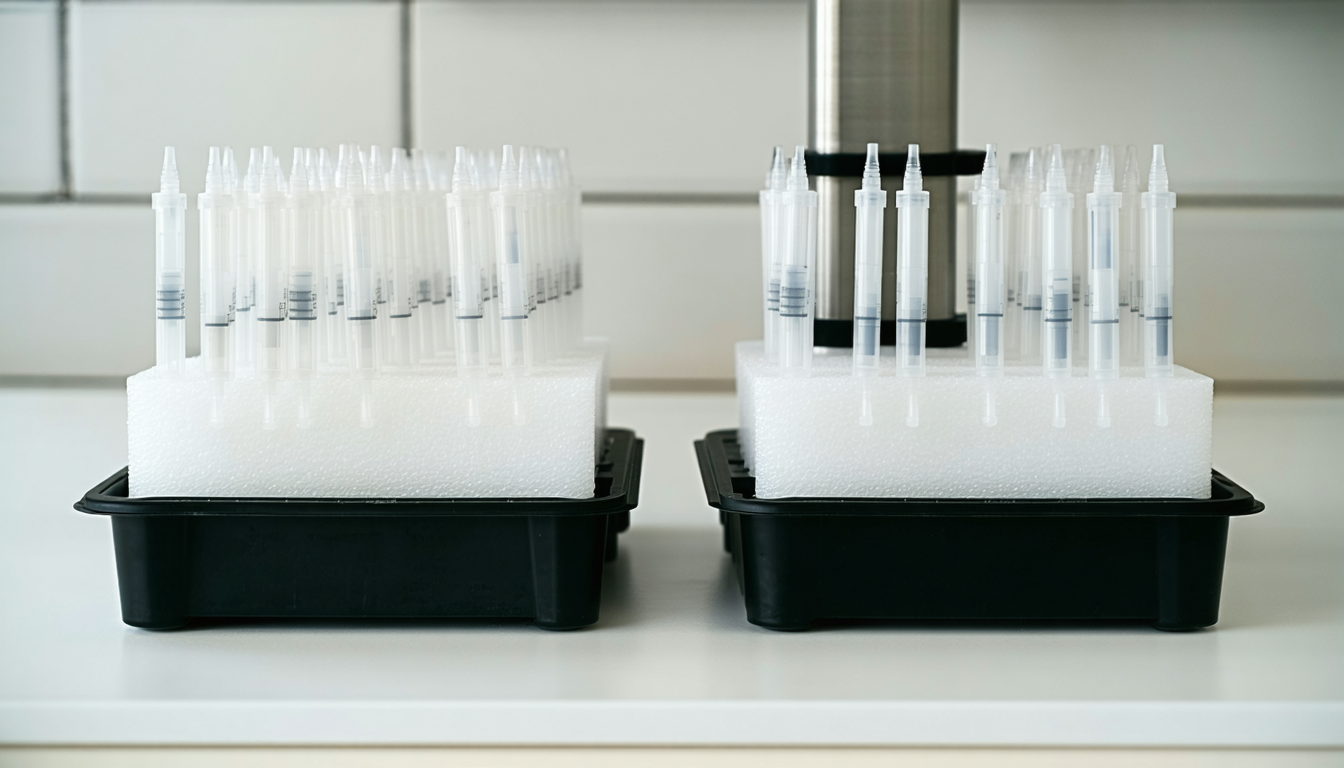
- Participants were randomly assigned to 15 mg tirzepatide alone, tirzepatide combined with one of several eloralintide doses, or placebo injections.
- Lilly's team recruited participants in the US and Argentina who were overweight or had obesity, and every one of them also had type 2 diabetes.
- STAT also reports an arm given the highest eloralintide dose on its own, which lost 11.1% of body weight after 48 weeks.
- The results were presented at the European Association for the Study of Diabetes annual meeting in Milan on 30 September.
Why it matters
- What it limits constraint Until Lilly reports results that count everyone randomised, nobody knows how large the add-on's advantage over the strongest approved drug is for a typical prescribed patient.
- Who has to decide decision Prescribers with patients already doing well on tirzepatide would have to weigh a larger average loss against more stomach side effects and a second drug, and Heisler doubts that favours switching.
- What it sets up precedent Any approval would rest on a single-injection version whose tolerability this trial did not measure, so Heisler's few-year timeline depends on how many people stay on the drug in the next trial.
Next story · Invest · 23h ago
CoreWeave's bond downgrade and AI-debt worries send investors into healthcare and Treasuries as yields fallConfirmed2 publishers
STAT reports the 23.3% figure for participants "who stayed on the treatment" at the top combination dose [4]. Against 14.8% on tirzepatide alone, that is a gap of 8.5 percentage points [22], or about 8.9 kg using New Scientist's averages of 24.5 kg and 15.6 kg [23]. The arms did not keep their participants equally [10]. Up to 27% of people in the combination groups dropped out, against 3% on tirzepatide alone and 17% on placebo [10]. At the high end, that is nine times the tirzepatide rate [18]. When attrition is that uneven, an on-treatment average describes the people who could tolerate the pair, and compares them with nearly everyone assigned to tirzepatide [4]. Neither report includes the weight loss counted across everyone randomised, including those who stopped.
Suppose the top-dose arm lost the highest dropout rate reported for any combination group, 27%, and every one of those people lost no weight at all. The arm's average would still be about 17.0% [19]. Treating tirzepatide's 3% dropout the same way gives about 14.4% [20]. Under those deliberately harsh assumptions the combination still leads, by about 2.6 points instead of 8.5 [21].
The placebo arm lost 3% [3], and randomisation against it is what lets the drugs take credit for the difference. "It's a pretty astonishing degree of weight loss," said David Preiss of the University of Oxford, who was not involved in the research [17]. Tirzepatide mimics two appetite-suppressing hormones, GLP-1 and GIP [7]. Eloralintide targets a third, amylin [6]. Lora Heisler of the University of Aberdeen, who was also not involved, said adding a drug that acts like amylin alongside tirzepatide effectively brings a third appetite-regulating pathway into play, and that this may explain why the combination appears to deliver substantially greater weight loss [11].
On blood sugar, the combination's edge over tirzepatide is small. The high-dose combination beat tirzepatide alone by half a percentage point [24], while tirzepatide beat placebo by 2.1 points [25]. "These are massive reductions [with EloraTZP]," Preiss said [13]. He said he would expect the changes to lower the risk of cardiovascular complications and high blood pressure, though further studies are needed [27].
In a clinic, the question is whether people keep taking it. Mild to moderate diarrhoea, nausea and vomiting were more common on the combination [9]. Preiss said those side effects are probably why so many in the combination groups dropped out [10]. "They might find the combination more difficult to tolerate; if the patient's already doing well on a drug like tirzepatide, then additional benefit may not outweigh the added treatment burden or side effects," Heisler said [14]. Preiss added that people who only need to lose a small or moderate amount of weight may not be candidates for it [15].
In this trial the two drugs went in as separate weekly shots [6]. Lilly says the larger follow-up trial will give them as one weekly injection [16]. Regulators would therefore judge a different formulation from the one whose side effects were measured here. If all goes smoothly, the US Food and Drug Administration could approve the approach within a few years, Heisler said [28]. Weight-loss drugs consistently work better in people who have obesity without diabetes, for reasons Preiss said are unclear, and he expects EloraTZP could do more in that group once trials test it [26]. I'd expect the next trial to be judged on how many people stay on the drug at least as much as on the average weight they lose.
What to watch
- Whether Lilly publishes an analysis counting every randomised participant, including the combination-arm dropouts, and how far the 8.5-point lead shrinks in it.
- Dropout and gastrointestinal side-effect rates in the larger single-injection trial Lilly says will start by the end of the year.
- A trial of the combination in people with obesity but without type 2 diabetes, where Preiss expects bigger effects.
Clarity's read
What the record supports and how the coverage leans. The claims behind it follow.
Reality
- Evidence60
- Adoption
- Not scored
- Hype gap+30
- Incentives65
- Confidence55
Claim ledger
Ranked by verification strength, evidence, and original report placement.
- [1]
After eleven months, participants on 15 mg tirzepatide alone lost 15.6 kg, about 14.8% of body weight, on average.
- [2]
Participants on the highest eloralintide dose plus 15 mg tirzepatide lost about 24.5 kg on average, equivalent to 23.3% of body weight.
- [3]
The placebo group lost 3% of body weight on average.
- [4]
After 48 weeks, participants who stayed on the treatment at the highest dose of the combination lost 23.3% of their weight, more than those taking only Zepbound (14.8%) and only the highest dose of eloralintide (11.1%).
- [5]
Dan Skovronsky at Eli Lilly and colleagues recruited 367 people from the US and Argentina who were overweight or had obesity, all of whom had type 2 diabetes.
- [6]
Participants were randomly split into groups: some received 15 mg tirzepatide; others received varying doses of tirzepatide combined with eloralintide, a drug targeting the appetite-suppressing hormone amylin, delivered via a second weekly injection (named EloraTZP); the rest received placebo injections.
- [7]
Tirzepatide, sold as Mounjaro and Zepbound, is the most potent approved weight-loss drug, given by weekly injection, and mimics two appetite-suppressing hormones, GLP-1 and GIP.
- [8]
The findings were presented at the 62nd Annual Meeting of the European Association for the Study of Diabetes in Milan, Italy, on 30 September.
- [9]
Mild to moderate side effects such as diarrhoea, nausea and vomiting were more common in the EloraTZP groups than on tirzepatide alone or placebo.
- [10]
Up to 27% of those in the EloraTZP groups dropped out of the trial, versus 3% in the tirzepatide group and 17% in the placebo group; Preiss said side effects are probably why.
- [11]
"Adding a drug acting like amylin [alongside tirzepatide] effectively brings a third appetite-regulating pathway into play, which may explain why the combination appears to deliver substantially greater weight loss," said Lora Heisler of the University of Aberdeen, who was not involved in the work.
- [12]
Blood sugar levels fell 2.4% on average in the tirzepatide group, 2.9% in the high-dose EloraTZP group and 0.3% in the placebo group.
- [13]
"These are massive reductions [with EloraTZP]," said David Preiss.
- [14]
"They might find the combination more difficult to tolerate; if the patient's already doing well on a drug like tirzepatide, then additional benefit may not outweigh the added treatment burden or side effects," said Heisler.
- [15]
Preiss said some people would only benefit from losing small or moderate amounts of body weight, so EloraTZP may not be the right approach for them.
- [16]
A larger trial of EloraTZP, delivered as a single weekly injection, is set to launch by the end of the year, the team wrote in a press release.
- [17]
"It's a pretty astonishing degree of weight loss," said David Preiss at the University of Oxford, who was not involved in the research.
- [18]
At its highest, combination-group dropout was nine times the tirzepatide-alone dropout rate.
- [19]
If 27% of the top-dose combination arm dropped out and each dropout lost no weight, the arm's average loss would be about 17.0%.
- [20]
If 3% of the tirzepatide arm dropped out and each dropout lost no weight, the arm's average loss would be about 14.4%.
- [21]
Under the zero-loss-for-dropouts assumption, the combination's lead over tirzepatide alone shrinks to about 2.6 percentage points.
- [22]
The top-dose combination's weight loss exceeded tirzepatide alone by 8.5 percentage points.
- [23]
The top-dose combination group lost about 8.9 kg more on average than the tirzepatide-alone group.
- [24]
The high-dose combination reduced blood sugar 0.5 percentage points more than tirzepatide alone.
- [25]
Tirzepatide alone reduced blood sugar 2.1 percentage points more than placebo.
- [26]
Weight-loss drugs consistently have larger effects in people with obesity or overweight who do not have type 2 diabetes; Preiss said it is unclear why, but it suggests EloraTZP's benefits could be greater for such people, though further trials are needed.
- [27]
Preiss said he would imagine the blood sugar and weight reductions would reduce the risk of cardiovascular complications and high blood pressure, although further studies are needed.
- [28]
If all goes smoothly, the US Food and Drug Administration could approve the approach for wider use in the next few years, said Heisler.
Sources
2 independent publishers whose own reporting we read for this story.
- newscientist.com‘Astonishing’ weight loss when GLP-1 drug used with second medication
1 article · September 30, 2026
- statnews.comSTAT+: Eli Lilly’s Zepbound combined with amylin drug led to significant weight loss in mid-stage trial
3 articles · October 1, 2026
Topics and entities
Topics
- Amylin-based therapies
- Obesity drugs
Entities
- Eli Lilly
- Tirzepatide
- European Association for the Study of Diabetes
- US Food and Drug Administration