Google's Willow chip cultivates magic states with about 40x fewer errors
Google Quantum AI says magic state cultivation cut errors about 40x on its Willow chip, in a result published in Science. The up-to-95% overhead figure is an older estimate, and Google says the protocol still needs a larger-scale demonstration.
The Engineer · Build desk
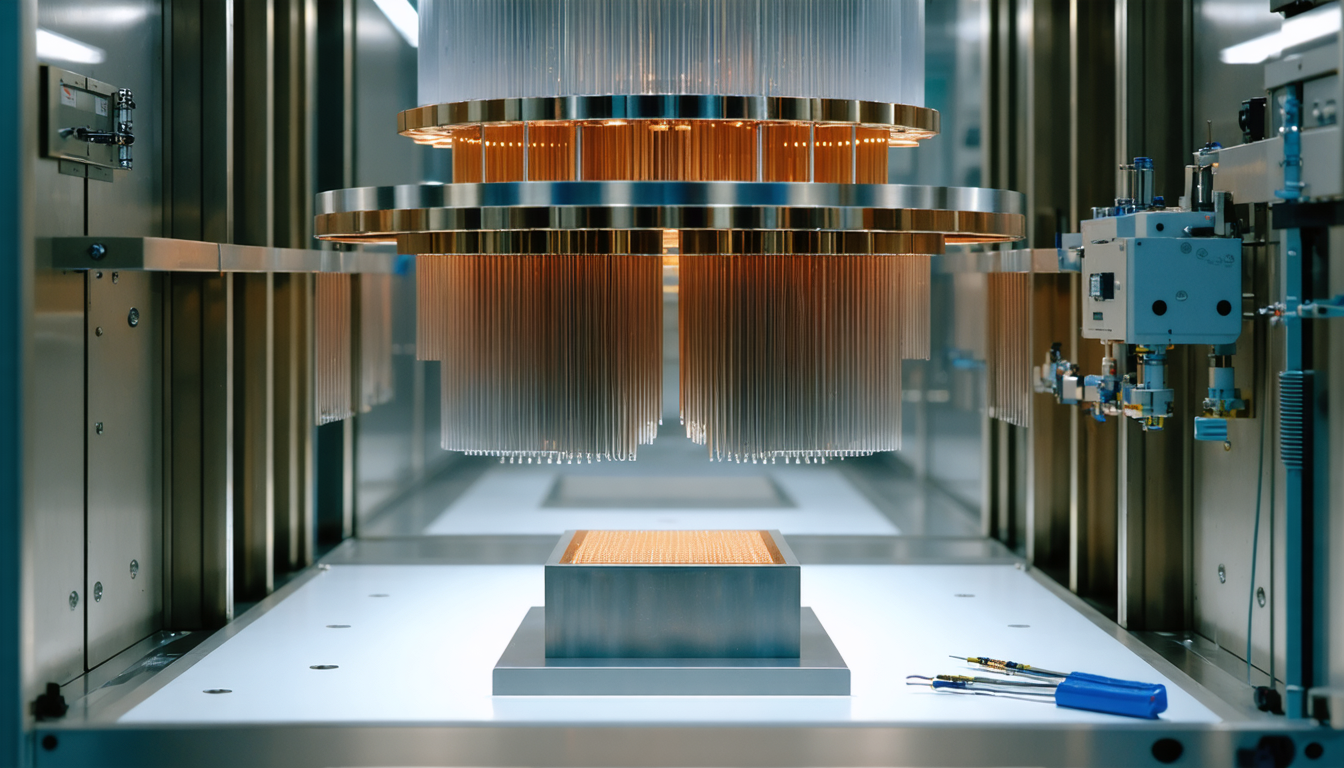
Key figures: Google reports a record logical fidelity of 99.99% for its T-states. That is an infidelity of 0.01%, or 1 in 10,000. Some estimates Google cites say up to 95% of a quantum computer's capacity might need to go to making magic states.
| Figure | Value | Note | Claim |
|---|---|---|---|
| Logical fidelity of Google's T-states, a record | 99.99% | 4 | |
| Infidelity, 1 in 10,000 | 0.01% | 13 | |
| Capacity that might go to making magic states, up to | 95% | per some estimates Google cites | 5 |
What happened
- The protocol injects a noisy state into a small region of the chip, runs coordinated measurements, and removes the flawed attempts.
- Google says it produced T-states with a record logical fidelity of 99.99%.
- The team also grafted states from a distance-3 color code into a distance-5 surface code on the hardware.
- Google researchers Craig Gidney, Noah Shutty and Cody Jones developed cultivation in 2024, building on an idea from the literature.
Why it matters
- What it costs cost Magic states are consumed on use, so whatever cultivation costs per state is paid again for every state a program burns.
- Who has to decide decision Anyone sizing a fault-tolerant machine has to decide how much of cultivation's gain to bank before the larger-scale run Google says it still needs.
- Who's exposed exposure The 40x comes with a benchmark the team invented, so it transfers to another chip only if that chip's drift and temperature noise can be controlled the same way.
Next story · Science · yesterday
Google's Willow chip cultivates magic states with errors cut roughly 40-foldConfirmed3 publishers
The 40x and the 95% measure different things. The 40x is a ratio of error rates between cultivated and un-cultivated states on Willow [3]. The 95% is an older estimate of the share of a quantum computer's capacity that might go to making magic states [5].
Getting from one to the other takes three inputs: the error rate each finished state must reach, how many attempts the filter discards to reach it [9], and how many qubits sit occupied while it runs. The 99.99% logical fidelity [4] works out to an infidelity of 0.01%, or 1 in 10,000 [13]. The post does not report the discard rate.
The path to the 40x included months of results that did not make sense. When the team first tested the protocol, research scientist Emma Rosenfeld saw data that seemed to defy the laws of physics [10]. After months of confusion, simulations and consistency checks, she traced it to an incorrect assumption in the team's go-to measurement technique: noise from electrical equipment drift and temperature variation was interfering with the benchmark's validity [10]. In our view, that check is what makes the later number believable. The team then added extra control to the system to reduce the noise and invented a new benchmarking technique that uses cultivation to measure itself [11].
Every figure here comes from Google's own post about its Science paper [2]. The post is direct about the limit. Google wrote that "we still need to demonstrate magic state cultivation at a larger scale to make it realistic" [7].
What to watch
- A cultivation demonstration at a larger code scale than the distance-3 to distance-5 grafting Google reported.
- A published acceptance rate for the filter, which would let outsiders turn the 40x into a qubit-overhead figure.
- A second lab reproducing the error reduction on different hardware with its own benchmark.
Clarity's read
What the record supports and how the coverage leans. The claims behind it follow.
Reality
- Evidence68
- Adoption
- Not scored
- Hype gap+30
- Incentives60
- Confidence72
Perspective Coverage
5 publishers- Builder
- Builder 41%
- Operator
- Operator 21%
- Investor
- Investor 38%
Claim ledger
Ranked by verification strength, evidence, and original report placement.
- [1]
Google Quantum AI says it has shown that magic state cultivation works in practice on its Willow processor, reducing errors about 40x compared to without it.
- [2]
Google says the magic state cultivation work is published in Science.
- [3]
On Willow, the protocol achieved a 40-fold reduction in errors relative to un-cultivated states.
- [4]
Google says it got T-states with a record logical fidelity of 99.99%.
- [5]
Some estimates have shown that up to 95% of a quantum computer's entire capacity might need to be dedicated to making magic states.
- [6]
Once a magic state is used it cannot be re-used, which makes magic states a scarce resource.
- [7]
Google wrote: "we still need to demonstrate magic state cultivation at a larger scale to make it realistic".
- [8]
In 2024 Google Quantum AI researchers Craig Gidney, Noah Shutty and Cody Jones harnessed an idea from the literature, refined it, and developed what is now called magic state cultivation.
- [9]
Cultivation acts like a filter: a noisy state is injected into a small region of a quantum chip, then a series of highly coordinated measurements checks for errors and removes flawed attempts.
- [10]
When first testing the cultivation protocol, research scientist Emma Rosenfeld saw data that seemed to defy the laws of physics. After months of confusion, simulations, discussions and consistency checks, she found it arose from an incorrect assumption in the team's go-to measurement technique: noise from electrical equipment drift and temperature variation interfered with the benchmark's validity.
- [11]
The team added extra control to the system to reduce the impact of the noise and invented a new benchmarking technique that uses cultivation as a tool to measure itself.
- [12]
The team switched between color codes and surface codes, grafting states from a distance-3 color code to a distance-5 surface code.
- [13]
A logical fidelity of 99.99% corresponds to an infidelity of 0.01%, or 1 in 10,000.
Sources
5 independent publishers whose own reporting we read for this story.
- blog.googleBringing the magic: Google breaks open a bottleneck in quantum computing
1 article · October 15, 2026
- crypto.newsGoogle cuts quantum errors 40-fold: Is Bitcoin at risk?
1 article · October 16, 2026
- decrypt.coGoogle Says It Just Cracked One of Quantum Computing's Biggest Bottlenecks
1 article · October 15, 2026
- interestingengineering.comGoogle’s quantum chip cuts magic-state errors 40-fold, reaches 99.99% fidelity
1 article · October 15, 2026
- news.bitcoin.comGoogle Touts ‘Magic’ Quantum Breakthrough as Bitcoin Q-Day Threat Looms
1 article · October 15, 2026
Topics and entities
Entities
- Google Quantum AI
- Science
- Coinbase
- Magic state cultivation
- Willow