Violet-blue light kills all 64 Campylobacter strains from UK poultry in Reading lab tests
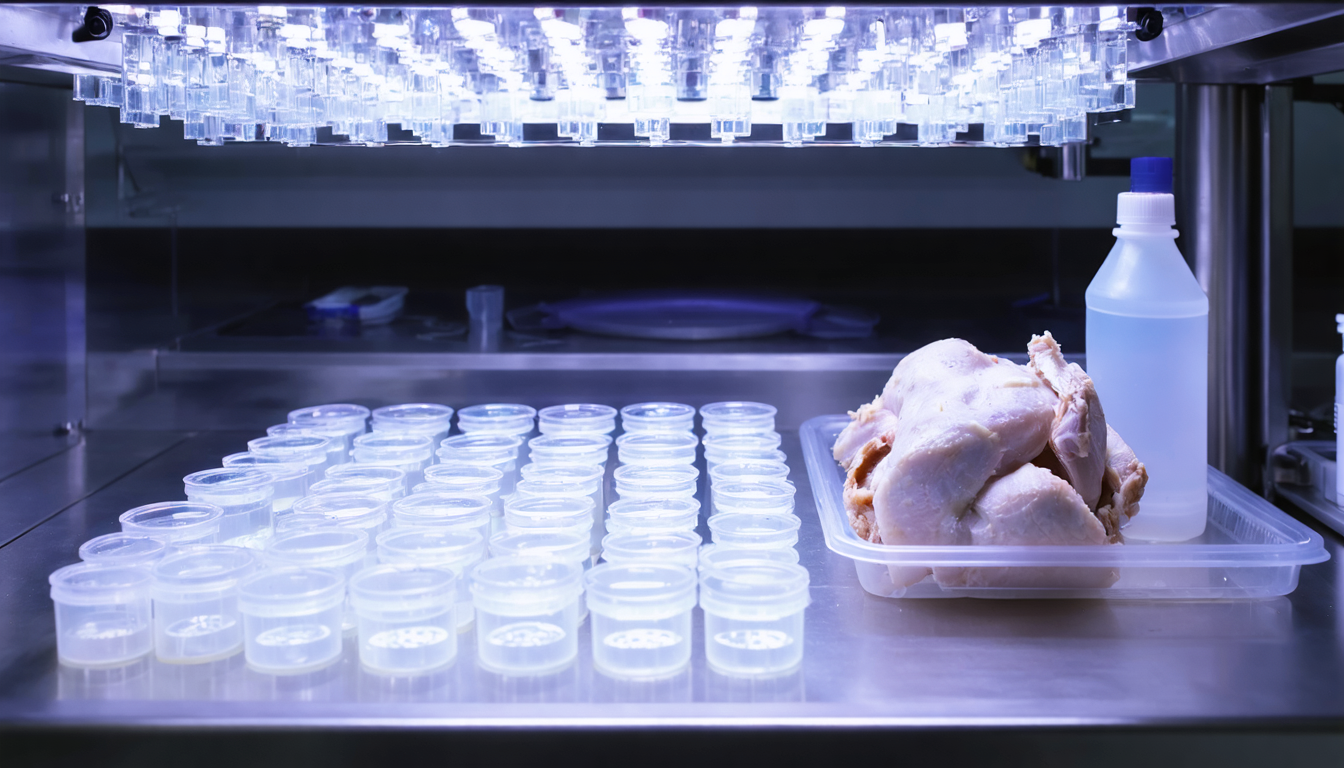
University of Reading researchers killed all 64 Campylobacter strains they tested, antibiotic-resistant ones included, using low-power violet-blue light. Whether it can replace chemical washes on carcasses depends on meat trials still to come.
The Scientist · Science desk
What happened
- Campylobacter is found on around three-quarters of all raw chicken sold in the UK, according to the University of Reading team's account.
- The light makes molecules already inside the bacteria produce lethal levels of reactive oxygen species, with no contact with the food and no added chemicals.
- One strain was exposed to the light over 15 rounds in an attempt to force resistance to evolve, and its tolerance did not increase.
Why it matters
- What's now possible capability Resistant and susceptible strains died alike, so if a light step works on meat, rising antibiotic resistance in poultry Campylobacter would not blunt it.
- What it costs cost If meat trials succeed, producers would mainly be paying for long-life, low-power LEDs, a cost the team thinks is low enough for plants in low- and middle-income countries.
- Who has to decide decision European processors, where chlorinated chicken is uncommon, would gain a carcass contamination control that does not require adopting the chlorine washes common in the US.
Next story · Science · Sep 27
Otago's CRISPR method mutates phage genes across the genome to find the essential onesConfirmed2 publishers
The strength of the design is the panel of 64 isolates. The strains came from the Animal and Plant Health Agency's surveillance programme, so the test covered the range of Campylobacter actually circulating in UK poultry, beyond laboratory reference strains [11]. A study on one or two reference strains could not show whether a wild multidrug-resistant isolate would survive the light. This one could. "We've shown it works against a wide range of real-world strains taken directly from U.K. poultry, including the multidrug-resistant strains that worry us most, and we can't find any evidence that resistance could evolve," said Dr Aidan Taylor of the University of Reading, the lead author [4].
The thing this doesn't tell you is the size of the kill. The phys.org account of the Microbiology paper [2] does not give the light dose, the exposure time or the fraction of bacteria left alive. A processing plant would need those figures to judge whether the step fits a line. A dead culture in a lab is also a different result from a clean carcass. Dr Samuel Connelly of the Animal and Plant Health Agency, who co-led the research, said: "While further evaluation using contaminated meat samples is required, the simplicity and adaptability of this technology suggest that it could be implemented at various stages of the food production process." [12]
Taylor rests the durability claim on the chemical-free design. "What's exciting about this light-based approach is that it doesn't rely on chemicals or antibiotics at all, so it sidesteps the resistance problem entirely," he said [7]. The experimental support is a forced-evolution run on a single strain, and 15 rounds produced no rise in tolerance [1]. That shows tolerance did not emerge under those conditions. A longer run across several strains would be the stronger test.
Cooking kills Campylobacter, and cross-contamination from handling raw meat is thought to be the main route of infection [10]. The bacterial load on raw carcasses is what a processing step can change. The team's retail estimate, from about 1 in 10 highly contaminated carcasses to 1 in 50 [9], is a fivefold fall, from 10% to 2% of carcasses [15][16]. It assumes a 100-fold cut in contamination that no meat trial has yet measured.
The comparison with chlorine comes from earlier research that found blue light could work better than chlorine against specific strains [13]. This study tested the light alone. In my view the new paper makes violet-blue light a credible candidate for a post-slaughter carcass step [8]. That holds on one condition: the meat trials have to show a large kill at a dose a line can deliver. The bacterium causes hundreds of thousands of UK cases a year, at an estimated cost of 700 million pounds in health care and lost productivity [6].
What to watch
- Results from contaminated-meat trials, especially the kill achieved on carcass surfaces and whether it approaches the 100-fold reduction the retail model assumes.
- Publication of the light dose and exposure time per kill, which decide whether the step fits a processing line's speed.
- Resistance-evolution experiments run longer than 15 rounds and across more than one strain.
Clarity's read
What the record supports and how the coverage leans. The claims behind it follow.
Reality
- Evidence55
- Adoption
- Not scored
- Hype gap+25
- Incentives35
- Confidence60
Claim ledger
Ranked by verification strength, evidence, and original report placement.
- [1]
When one strain was repeatedly exposed to the light over 15 rounds in the laboratory, in an attempt to force resistance to evolve, no increase in tolerance was seen.
- [2]
Researchers from the University of Reading, working with the Animal and Plant Health Agency, tested violet-blue photodynamic inactivation (VB-PDI) against 64 strains of Campylobacter in a study published in the journal Microbiology.
- [3]
Every strain was killed by the treatment regardless of species or antibiotic resistance profile; strains already resistant to antibiotics were killed just as effectively as fully susceptible ones.
- [4]
"We've shown it works against a wide range of real-world strains taken directly from U.K. poultry, including the multidrug-resistant strains that worry us most, and we can't find any evidence that resistance could evolve."
- [5]
Campylobacter is found in around three-quarters of all raw chicken sold in the UK.
- [6]
In the UK there are hundreds of thousands of Campylobacter cases each year, costing an estimated 700 million pounds annually in health care and lost productivity.
- [7]
"What's exciting about this light-based approach is that it doesn't rely on chemicals or antibiotics at all, so it sidesteps the resistance problem entirely."
- [8]
VB-PDI shines visible violet-blue light onto bacteria, causing molecules naturally found inside their cells to produce lethal levels of reactive oxygen species; it needs no physical contact with the food and no added chemicals, making it a promising option for poultry carcasses in processing plants after slaughter.
- [9]
The researchers estimate that if the technique could reduce contamination of chicken carcasses by a factor of 100, the proportion of highly contaminated carcasses reaching retail could fall from around 1 in 10 to 1 in 50.
- [10]
Cooking kills Campylobacter, and cross-contamination from handling raw meat is thought to be the main route of infection.
- [11]
The Animal and Plant Health Agency surveillance programme supplied a detailed picture of Campylobacter strains circulating in UK poultry, allowing the technology to be tested against a real diversity of bacteria rather than laboratory strains alone.
- [12]
"While further evaluation using contaminated meat samples is required, the simplicity and adaptability of this technology suggest that it could be implemented at various stages of the food production process."
- [13]
Previous research showed blue light treatments could work more effectively than treating chicken with chlorine to kill specific strains of bacteria.
- [14]
Chlorinated chicken is common in the US but is not commonly found in Europe.
- [15]
In the team's estimate, a 100-fold cut in carcass contamination produces a fivefold fall in the share of highly contaminated carcasses reaching retail.
- [16]
The estimated share of highly contaminated carcasses at retail falls from 10% to 2%, a drop of 8 percentage points.
- [17]
VB-PDI uses simple, low-power LEDs with a long lifespan and minimal running costs, and the team believes it could offer a low-cost option for poultry producers, including in low- and middle-income countries where food safety infrastructure is limited.
Sources
2 independent publishers whose own reporting we read for this story.
- discovermagazine.comBlue Light Killed 64 Strains of Food Poisoning Bacteria and Could One Day Make Chicken Safer
1 article · October 6, 2026
- phys.orgBlue light could cut food poisoning from raw chicken
1 article · October 6, 2026
Topics and entities
Topics
- Photodynamic inactivation
- Antimicrobial resistance
- Poultry processing
Entities
- Animal and Plant Health Agency
- University of Reading
- Violet-blue photodynamic inactivation