NASA finds hitchhiking microbes could persist at the lunar south pole, on a one-day clock
A Science Advances paper says five ordinary human-associated microbes could stay alive in shadowed south-pole terrain. The expensive consequence is the baseline contamination survey it implies.
The Scientist · Science desk
What happened
- NASA scientists published findings on Aug. 19, 2026 in Science Advances saying some of Earth's microbes likely to travel to space with human explorers could survive in the shaded nooks and crannies of the Moon's South Pole region.
- In a study published in Science Advances, NASA researchers found that five kinds of microorganisms that could feasibly find their way aboard an upcoming Artemis moon mission may be able to live at the lunar south pole.
- The organisms studied were Aspergillus niger, Bacillus subtilis, Staphylococcus aureus, Deinococcus radiodurans, and several species of Fusarium.
- The team selected three species of bacteria and two fungi based on how easily they could find their way onto a moon-bound spacecraft; Saxena said, "We chose five guys off the street."
- Heather Graham said the reason for choosing pedestrian microorganisms rather than the hardiest known on Earth is that "the toughest aren't necessarily going to be the ones that end up there"; they are things hard to get rid of when cleaning spacecraft and working in clean rooms, and things seen on the space station.
Why it matters
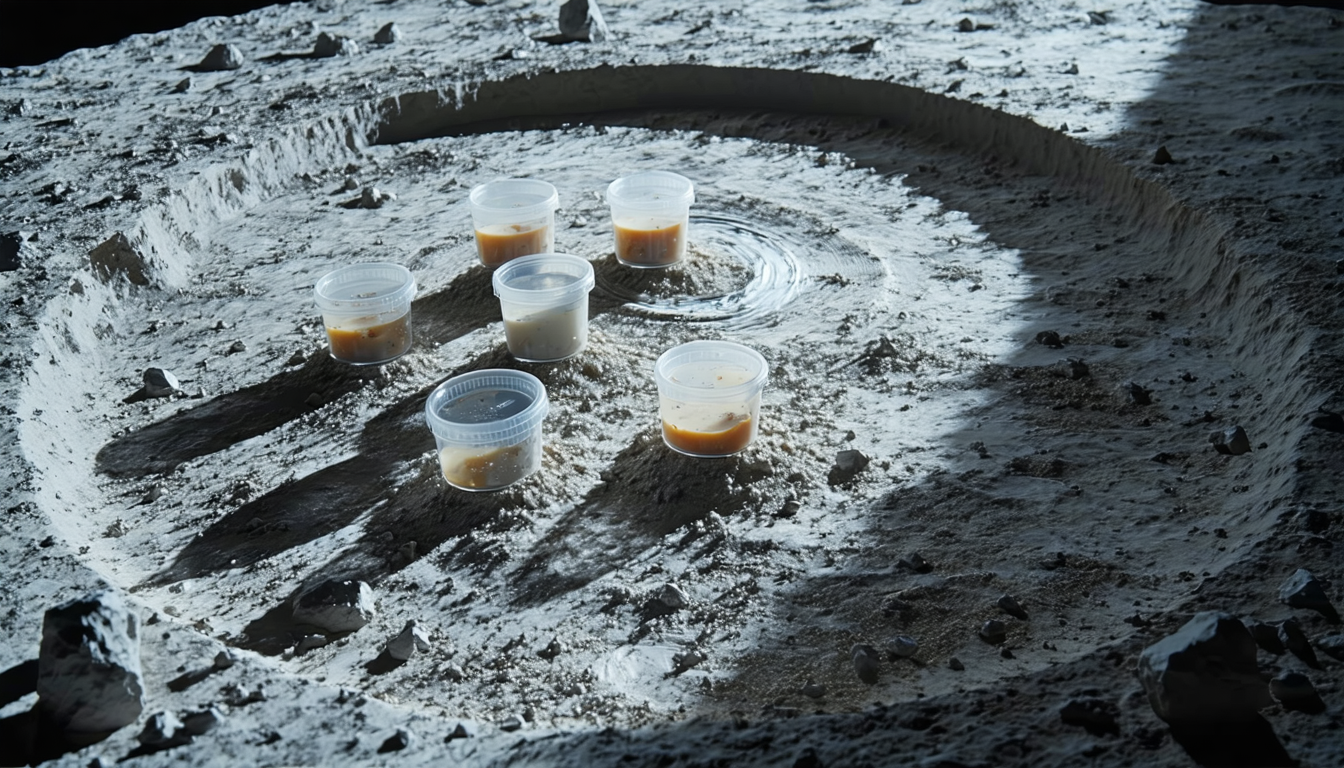
NASA scientists reported in Science Advances on Aug. 19, 2026 that Earth microbes carried along with human crews could survive in the shaded terrain around the Moon's south pole, testing five organisms that could plausibly reach an Artemis mission [1][2]. That is the same terrain NASA wants for bases and for sampling, because the permanent shadows sit inside large craters that may hold significant water ice [5], which moves planetary protection from a compliance exercise to a constraint on how crews collect and interpret samples [13]. Read the definition before the headline. Survival in this study means a microbe stays alive for at least one Earth day; it does not mean the organism grows or reproduces [3]. In shadowed conditions, according to Scientific American's account of the work, the organisms would enter a frozen sleep state, neither multiplying nor dying [4]. This is a paper about persistence, not about a lunar biosphere. The species list is deliberately unremarkable: Bacillus subtilis, Staphylococcus aureus, Deinococcus radiodurans, the fungus Aspergillus niger, and several Fusarium species [7]. Three bacteria and two fungi were picked for how easily they could reach a Moon-bound spacecraft rather than for being the hardiest life on Earth, a selection lead author Prabal Saxena of NASA Goddard described as "five guys off the street" [9][21]. Co-author Heather Graham said the toughest organisms are not necessarily the ones that end up there; the relevant ones are those that survive spacecraft cleaning and clean rooms and have already been found on the space station [10]. Aspergillus niger has been sampled inside the International Space Station, and experiments show it can survive outside it too [18]. Aaron Regberg, a geomicrobiologist at NASA Johnson and a co-author, noted these are not species usually classed as extremophiles: "I would have expected these microbes to have dried out" [19]. The geometry does the work. The Moon's very small axial tilt keeps the Sun hovering near the horizon at the poles, so crater ridges, mountains and even small bumps block light, creating cold pockets that preserve water and shield fragile molecules and possible microorganisms from lethal radiation [6]. Surface temperatures at the south pole run from about -330 degrees Fahrenheit in shadow to 130 degrees in sunlight [22], a spread of 460 degrees [24]. The operationally awkward part is Saxena's observation that these shelters are not only mapped craters: because the Sun never climbs high, an astronaut's footprint can create a micro permanently shadowed region [8]. Crew activity manufactures the habitat. Sterilisation cannot close the gap. NASA often bakes robotic spacecraft above 400 degrees Fahrenheit to cut their microbial load, which is not an option for astronauts [17], and humans carry roughly a million bacteria on each eraser-sized patch of skin, venting from suits and habitats [15]. So the authors put a prerequisite ahead of the science: a baseline measurement of what contaminants humans bring [11]. Andrew Needham, a Goddard co-author and Artemis contamination-control scientist for lunar samples, framed it as a Mars problem in advance: "We need to understand what was there before us, because when we go to Mars to search for signs of life beyond our planet, we will want to make sure it's not stuff we brought" [12]. Graham's version is narrower and more immediate: Artemis treats the Moon as a window onto early Earth, so the chemical signal has to be lunar rather than delivered [14], and crews will need the actual composition of the regolith to judge questions like protosoil fertility [16]. Watch whether a pre-crew contamination baseline is funded and flown before astronauts land on Artemis IV, which Scientific American reports could happen as soon as 2028, with a permanent base targeted for 2036 [23][11].
Clarity's read
What the record supports and how the coverage leans. The claims behind it follow.
Reality
- Evidence60
- Adoption
- Not scored
- Hype gap+20
- Incentives40
- Confidence58
Perspective Coverage
4 publishers- Builder
- Builder 31%
- Operator
- Operator 63%
- Investor
- Investor 6%
Claim ledger
Ranked by verification strength, evidence, and original report placement.
- [1]
NASA scientists published findings on Aug. 19, 2026 in Science Advances saying some of Earth's microbes likely to travel to space with human explorers could survive in the shaded nooks and crannies of the Moon's South Pole region.
- [2]
In a study published in Science Advances, NASA researchers found that five kinds of microorganisms that could feasibly find their way aboard an upcoming Artemis moon mission may be able to live at the lunar south pole.
- [3]
Survival in this study means the microbe can stay alive for at least one Earth day, which does not mean that it can grow and reproduce.
- [4]
In the lunar polar environment many microorganisms would enter a kind of frozen sleep state: they would not necessarily grow, but they also would not die, and permanently shadowed regions would shield them from extreme heat or solar radiation.
- [5]
Permanently shadowed regions are typically found inside large craters that could contain significant amounts of water ice, making them attractive potential sites for NASA's planned lunar bases.
- [6]
Because the Moon has a very small axial tilt, the Sun appears from the poles to hover just above the horizon, so elevated terrain including crater ridges, mountains and even small bumps blocks light from low-lying ground, producing shadowed pockets that stay cold, preserve water, and shield fragile molecules and possible microorganisms from lethal radiation.
- [7]
The organisms studied were Aspergillus niger, Bacillus subtilis, Staphylococcus aureus, Deinococcus radiodurans, and several species of Fusarium.
- [8]
Saxena said there are also micro PSRs: because the Sun never gets high in the sky in the polar regions, an astronaut footprint can create a mini permanently shadowed region.
- [9]
The team selected three species of bacteria and two fungi based on how easily they could find their way onto a moon-bound spacecraft; Saxena said, "We chose five guys off the street."
- [10]
Heather Graham said the reason for choosing pedestrian microorganisms rather than the hardiest known on Earth is that "the toughest aren't necessarily going to be the ones that end up there"; they are things hard to get rid of when cleaning spacecraft and working in clean rooms, and things seen on the space station.
- [11]
The authors say that before any surface science can happen, scientists need a baseline measurement of what contaminants humans bring.
- [12]
Andrew Needham, a NASA Goddard-based co-author and Artemis contamination-control scientist for lunar samples, said: "We need to understand what was there before us, because when we go to Mars to search for signs of life beyond our planet, we will want to make sure it's not stuff we brought."
- [13]
As humans build a permanent presence on the Moon, it may become difficult to distinguish ancient lunar chemistry from contamination delivered by visiting astronauts, and the concern extends beyond the Moon to Mars.
- [14]
Graham said much of Artemis aims to understand the Moon as a window onto early Earth, so researchers want to be sure they are looking at native materials and a chemical signal arising from the Moon rather than contaminating that signal through their own activities.
- [15]
Humans have, on average, 1 million bacteria living on each patch of skin the size of a pencil eraser, and these bacteria vent from spacesuits and habitats.
- [16]
Astronauts will need to know things like the exact chemical composition of lunar soil, for example to set up farms to grow food, and Graham cited questions about the potential fertility of these protosoils and what has been preserved from exogenous organics arriving on the surface.
- [17]
NASA often bakes robotic spacecraft at temperatures above 400 degrees Fahrenheit to reduce the number of living organisms on them, but that is not possible with astronauts.
- [18]
Astronauts have sampled Aspergillus niger inside the International Space Station, and experiments demonstrate the fungus can survive outside the station as well; it was selected for the study because of its known toughness in spaceflight environments.
- [19]
Aaron Regberg, a geomicrobiologist at NASA's Johnson Space Center and a paper co-author, said these species are typically not considered extremophiles, and that "I would have expected these microbes to have dried out."
- [20]
The paper's authors argue the Moon should be used as a natural laboratory, with shaded areas around the South Pole used to carefully test the real-life limits of microbial survival in an environment that cannot easily be reproduced on Earth.
- [21]
Prabal Saxena is a planetary scientist who led the study from NASA's Goddard Space Flight Center in Greenbelt, Maryland.
- [22]
Lunar south pole temperatures can veer between about -330 degrees Fahrenheit (about -201.1 Celsius) in the shadows and 130 degrees Fahrenheit (54.4 Celsius) in areas exposed to sunlight.
- [23]
Astronauts are slated to set foot on the Moon as part of the Artemis IV mission as soon as 2028, and NASA hopes to establish a permanent base by 2036.
- [24]
The stated shadow-to-sunlight temperature spread at the lunar south pole is 460 degrees Fahrenheit.
Sources
3 independent publishers whose own reporting we read for this story.
- discovermagazine.comShady Spots on Moon’s South Pole May Provide Refuge for Earth Microbes to Survive for Up to Seven Days
1 article · August 21, 2026
- nasa.govHuman-Related Microbes May Survive Moon’s South Pole, NASA Finds
1 article · August 19, 2026
- phys.orgHuman-related microbes may survive moon's South Pole
1 article · August 19, 2026
- scientificamerican.comSome microbes could survive on the moon—that’s a big problem for NASA
1 article · August 19, 2026
Topics and entities
Entities
- NASA Johnson Space Center
- NASA Goddard Space Flight Center
- Lunar Reconnaissance Orbiter
- Bacillus subtilis
- Staphylococcus aureus
- International Space Station
- NASA
- Science Advances
- Aspergillus niger
- Deinococcus radiodurans
- Artemis Program