Nylon shades that block 60% of light eased bleaching in Florida Keys brain corals
Nova Southeastern researchers who cut light by 60% over Florida Keys brain corals in 2024 saw them bleach less than 20 unshaded controls. The summer killed no coral in either group, so the result supports shading as short-term protection for a few chosen colonies.
The Scientist · Science desk
What happened
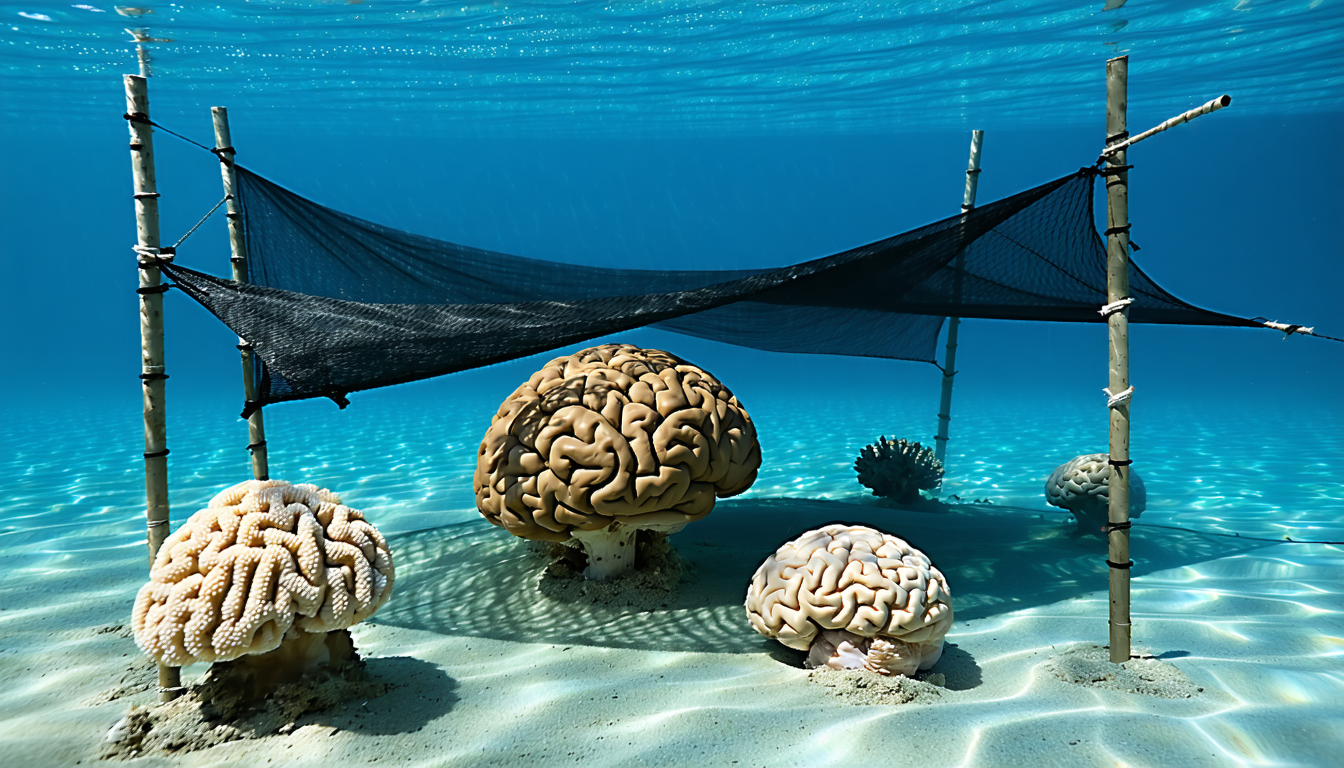
- The trial covered two brain coral species, Pseudodiploria clivosa and Colpophyllia natans, under 20 custom shades at Newfound Harbor.
- Each shade was a pipe frame with nylon cloth, tied to the seabed with cord and floating 30 centimeters above a coral.
- Heat stress at Newfound Harbor that summer was the second-highest on record, and the gap in color loss was widest during the hottest stretches.
- Shaded corals regained some of their color after the shades went in.
- Bleaching was milder than expected overall, possibly because most corals hosted heat-tolerant Durusdinium algae after the record 2023 heat wave.
Why it matters
- What it limits constraint With no deaths among the controls, the trial could not test whether shading changes survival, the outcome a reef manager is spending money to protect.
- What's now possible capability Shades helped even when installed after the water was hot enough to bleach coral, so managers can still act once a heat wave is underway.
- Who has to decide decision Because one shade covers one colony, deploying them means choosing in advance which corals to save and leaving the rest exposed.
Next story · Science · 2d ago
One week of contact with a healthy neighbor restarted recovery in bleached coral at StanfordConfirmed3 publishers
A shade does nothing to water temperature [8]. It blocks the UV and irradiance damage that makes heat damage to corals worse [8], and the nylon over these colonies let through about 40% of the light [20]. Divers returned every two weeks to score color and biopsy the algae living in the coral tissue [9]. Color is a fair readout here. The algae supply most of a coral's food and give it its color, so a coral turning white has lost that partnership and is starving [10].
The trial grew out of the summer before. "The 2023 coral bleaching event in Florida essentially wiped out branching corals, and at some inshore sites had a devastating impact on brain corals," said Karen Neely of Nova Southeastern University, lead author of the paper in Frontiers in Marine Science [3][17]. "This study stemmed directly from that event: we wanted to provide proof of concept for tools to save targeted corals in similar future events." [18]
Proof of concept is what it delivered, with color as nearly the whole evidence. "Shades reversed the observed bleaching, but the event wasn't severe enough to cause mortality on control or shaded corals," Neely said [5].
The biopsies could not back the color data up. Algae density and species matched across the two groups [12]. Permits required sampling from colony edges, which get less light and bleach less, so even the control samples had some shade [12]. Permits also kept the shades out of the water until well after it was hot enough to bleach coral [13]. Both constraints would tend to shrink the measured gap between groups, and the team still reported a significant positive effect [13].
Mild bleaching still has costs. "However, we know that even bleaching that doesn't cause mortality can impact corals' future disease susceptibility and reproductive capacity," Neely said [21]. She suggested tracking disease and reproductive output after the shades come off to measure any lasting benefit [22].
On scale, Neely is direct. "Scaling is the big limitation of this study; shading is not a cure-all for coral reefs, and its use would require hard decisions about what corals are worth saving," she said [14]. "We found it was effective on two highly susceptible coral species, so it is likely to be useful for most others, but additional studies would be needed to confirm that." [23] She also said thermal stress would likely reach "a point at which no amount of shading could help" [15].
I think the evidence supports shades as a tool for a short list of named colonies in a bad summer, and Neely puts it the same way. "Solutions like shading can offer temporary protection on small scales," she said [19], after warning that "we absolutely have to address climate change to have any hope of reefs as we know them existing in the future" [16].
What to watch
- A repeat trial with shades in place before the water reaches bleaching temperature; permits delayed installation in 2024.
- A heat event severe enough to kill unshaded controls, the condition needed to measure whether shades change survival.
- Shading tests on coral species beyond Pseudodiploria clivosa and Colpophyllia natans, which Neely said are needed before assuming the effect generalizes.
Clarity's read
What the record supports and how the coverage leans. The claims behind it follow.
Reality
- Evidence55
- Adoption10
- Hype gap+25
- Incentives
- Not scored
- Confidence60
Perspective Coverage
3 publishers- Builder
- Builder 33%
- Operator
- Operator 55%
- Investor
- Investor 12%
Claim ledger
Ranked by verification strength, evidence, and original report placement.
- [1]
Heat stress at Newfound Harbor in summer 2024 was the second-highest on record; shaded corals lost less color than expected, with differences greatest during the most intense periods of thermal stress.
- [2]
Shaded corals recovered some of their color after the shades were installed.
- [3]
The study was led by Dr. Karen Neely of Nova Southeastern University and published in Frontiers in Marine Science.
- [4]
In summer 2024, Neely's team set up 20 custom-made shades over colonies of two brain coral species, Pseudodiploria clivosa and Colpophyllia natans, at Newfound Harbor in the Florida Keys.
- [5]
"Shades reversed the observed bleaching, but the event wasn't severe enough to cause mortality on control or shaded corals," said Neely.
- [6]
The team selected 20 matching corals to act as controls.
- [7]
The shades, made of pipes with nylon cloths attached, were temporarily fixed to the seabed with cord, floated 30 cm over each shaded coral, and reduced light by 60%.
- [8]
Shading cannot cool the water, but it prevents UV and irradiance damage, which makes heat damage to corals worse.
- [9]
Divers visited every two weeks to track color changes and take tissue biopsies to monitor the algae living in the corals' tissues.
- [10]
The symbiotic algae provide corals with most of their nutrition and lend them their color; corals turning white under heat stress indicates the relationship has broken down and the coral is starving.
- [11]
The team saw less bleaching than expected overall and no dead coral, possibly because after the 2023 heat wave most corals hosted Durusdinium algae, which are very heat-tolerant but associated with lower coral growth and possibly greater disease susceptibility.
- [12]
There were no differences in algae density or algae species between control and shaded groups; permits required sampling from coral edges, which are less exposed to light and bleach less, so even control samples received some shade.
- [13]
Permit constraints meant the shades could not be installed until well after water temperatures were high enough to bleach coral; earlier installation might have been more effective, but there was still a significant positive impact.
- [14]
"Scaling is the big limitation of this study; shading is not a cure-all for coral reefs, and its use would require hard decisions about what corals are worth saving," said Neely.
- [15]
Neely said it is also likely that "thermal stress would reach a point at which no amount of shading could help".
- [16]
"Heat-related coral bleaching is probably the biggest threat to reefs worldwide, and we absolutely have to address climate change to have any hope of reefs as we know them existing in the future," said Neely.
- [17]
"The 2023 coral bleaching event in Florida essentially wiped out branching corals, and at some inshore sites had a devastating impact on brain corals."
- [18]
"This study stemmed directly from that event: we wanted to provide proof of concept for tools to save targeted corals in similar future events."
- [19]
"Solutions like shading can offer temporary protection on small scales."
- [20]
The shades let through about 40% of the light reaching the corals.
- [21]
"However, we know that even bleaching that doesn't cause mortality can impact corals' future disease susceptibility and reproductive capacity."
- [22]
Neely said it would be interesting to quantify whether and how much the shades benefited the corals after removal by tracking disease and reproductive output.
- [23]
"We found it was effective on two highly susceptible coral species, so it is likely to be useful for most others, but additional studies would be needed to confirm that."
Sources
3 independent publishers whose own reporting we read for this story.
- eos.orgUnderwater Umbrellas Reduce—and Reverse—Coral Bleaching in the Caribbean
1 article · October 1, 2026
- gizmodo.comScientists Invent Underwater Umbrellas to Protect Coral Reefs—and It Appears to Be Working
1 article · October 1, 2026
- phys.orgUnderwater umbrellas for coral reefs could help protect against heat damage
1 article · October 1, 2026
Topics and entities
Entities
- Frontiers in Marine Science
- Nova Southeastern University
- Pseudodiploria clivosa
- Colpophyllia natans
- NOAA
- University of Delaware