Fruit-fly tests back AI-flagged BRSK1 variants as the cause of a developmental disorder in 10 people
Baylor researchers tied reduced BRSK1 function to a neurodevelopmental disorder in 10 people from seven families after an AI tool flagged the gene. The variant was already in sequencing data that standard analysis had left unsolved, so the gain came from reading that data again, and fruit-fly experiments supplied the functional evidence.
The Scientist · Science desk
What happened
- AI-MARRVEL ranks candidate variants by combining multi-omics databases, a patient's clinical presentation and functional data from model organisms.
- The team posted BRSK1 on GeneMatcher, a database that links geneticists studying the same candidate gene, and an international search expanded the cohort.
- Every affected person had some degree of global developmental delay, but severity differed markedly, even between relatives carrying the identical mutation.
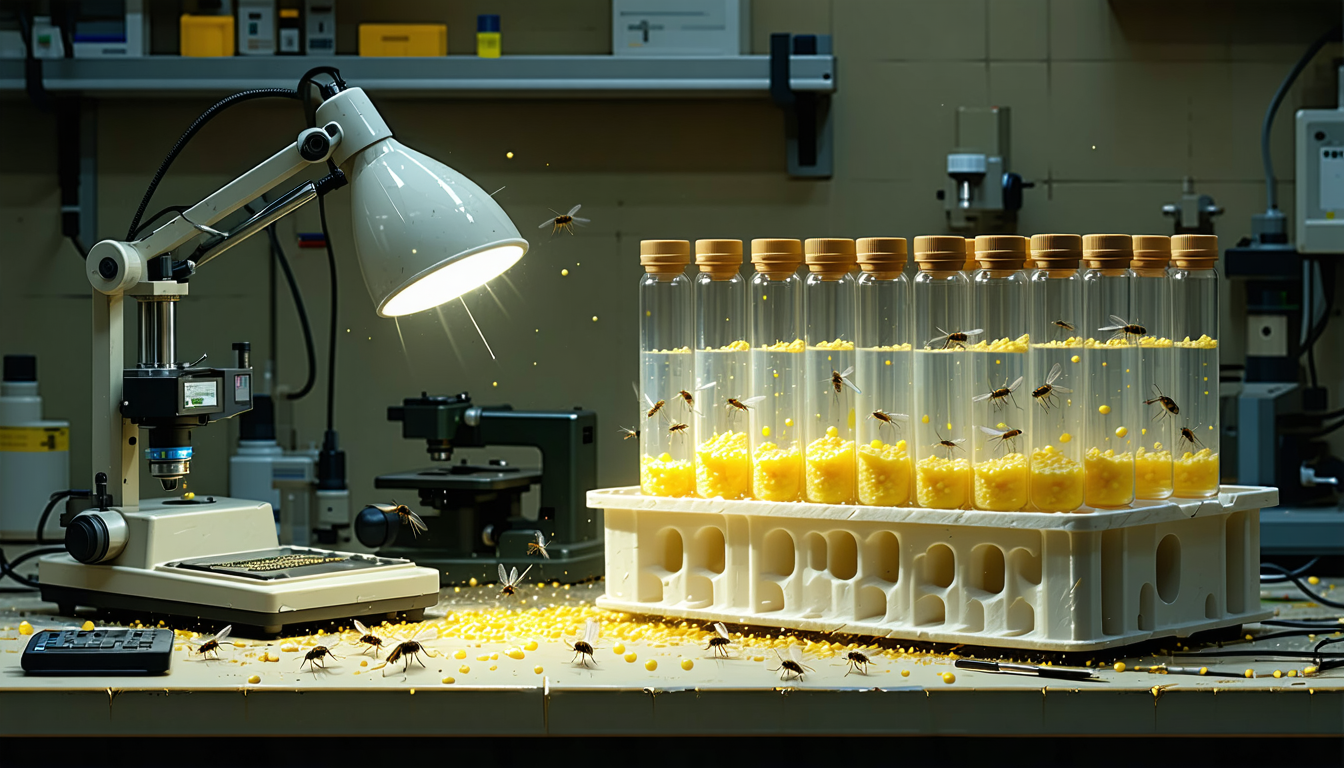
- In fruit flies, the patients' BRSK1 mutations lowered protein activity, raised levels of microtubule-organizing proteins and caused overgrowth at neuromuscular synapses.
- The study was led by Baylor College of Medicine, the Duncan NRI at Texas Children's Hospital and the Texome Project, and appears in the American Journal of Human Genetics.
Why it matters
- Who has to decide decision Families whose sequencing came back inconclusive have grounds to ask for their existing data to be reanalysed with newer variant-ranking tools before new tests are ordered.
- What it limits constraint A BRSK1 result can tell a family what caused the condition, but on current evidence it cannot tell parents how severe a particular child's case will become.
- What's now possible capability The fly model gives labs a functional test for BRSK1 variants found in future patients, so each new variant can be checked directly for reduced protein activity.
Next story · Science · Oct 7
Disinhibition gates how fruit flies lock a goal heading into a recurrent memory circuitConfirmed2 publishers
"Altogether, we studied 10 affected individuals from seven unrelated families," said Mingxi Deng, the study's first author and a postdoctoral fellow in the Bellen lab [6][8]. Seven is the figure to weigh first. It means the same gene turned up independently in seven households. Give each family one patient and three people are left over [16]. Each of those three is a relative of someone already counted.
The first patient came through the Texome Project, which offers free genomic testing to medically underserved families across Texas [13]. "Standard genetic analyses of a parent and child with the condition did not reveal an answer, but when a new artificial intelligence-based tool called AI-MARRVEL analyzed the genomic data, it highlighted a rare change in the BRSK1 gene as a promising candidate for a genetic diagnosis," said Hugo Bellen, a co-lead author and Distinguished Service Professor of Molecular and Human Genetics at Baylor [7][8]. By his account, the tool worked on genomic data the family already had. The release comes from Baylor and Texas Children's Hospital and was republished by Neuroscience News [15]. It says that even with exome sequencing, deciding which ultra-rare mutation actually causes disease "remains a formidable bottleneck" [14].
A ranked candidate is still a hypothesis. In my view, the independent families and the fly experiments together move BRSK1 from candidate to cause. The flies show that the patients' variants weaken the protein [1], and the release calls the disorder a partial loss of BRSK1 [2]. The thing this doesn't tell you is how an overgrown neuromuscular synapse in a fly relates to delayed speech in a child. The flies were used to test protein function and synapse structure. Speech, attention and autism traits were assessed only in the patients [10].
The picture in patients varies widely. Speech delay, intellectual disability, autism traits, anxiety, ADHD, low muscle tone and a small head size all appear in the cohort, and two people had seizures [10]. Two of 10 is 20 percent [17]. With a group that small, the share for any one symptom could change noticeably as more patients are reported.
The evidence for the gene is stronger than the evidence for the tool. AI-MARRVEL supplied the lead in one child whose standard analysis had stalled [3]. The release does not say how many other unsolved cases the tool has reanalysed, or how often the variants it ranks highest turn out to be harmless.
What to watch
- Further BRSK1 cases reported through GeneMatcher or clinical labs, which would firm up symptom frequencies currently based on 10 people.
- Published figures on how often AI-MARRVEL solves unsolved cases and how often it ranks a harmless variant highly, including in Texome Project cases.
- Whether mammalian or human-neuron models reproduce the microtubule and synapse changes seen in flies.
Clarity's read
What the record supports and how the coverage leans. The claims behind it follow.
Reality
- Evidence62
- Adoption
- Not scored
- Hype gap+30
- Incentives40
- Confidence60
Claim ledger
Ranked by verification strength, evidence, and original report placement.
- [1]
Functional modeling in Drosophila revealed that patient-derived BRSK1 mutations reduce protein activity, elevate microtubule-organizing proteins, and trigger abnormal structural overgrowth at neuromuscular synapses.
- [2]
The release frames the syndrome as linked to partial loss of BRSK1 and states that reduced BRSK1 function disrupts microtubule organization and synaptic structure.
- [3]
Standard parent-child trio sequencing of a pediatric patient enrolled in the Texome Project initially failed to yield a clear molecular diagnosis.
- [4]
AI-MARRVEL is an artificial intelligence tool designed to prioritize pathogenic mutations by integrating multi-omics databases, clinical presentation and model organism functional data; it surfaced a rare BRSK1 variant as a prime candidate.
- [5]
The researchers broadcast their candidate through GeneMatcher, a global networking database that connects geneticists evaluating identical candidate genes, and the international search expanded the cohort.
- [6]
Altogether, we studied 10 affected individuals from seven unrelated families
- [7]
Standard genetic analyses of a parent and child with the condition did not reveal an answer, but when a new artificial intelligence-based tool called AI-MARRVEL analyzed the genomic data, it highlighted a rare change in the BRSK1 gene as a promising candidate for a genetic diagnosis
- [8]
Hugo Bellen is co-lead author, Distinguished Service Professor of Molecular and Human Genetics at Baylor and chair in neurogenetics at the Duncan NRI; Mingxi Deng is first author and a postdoctoral fellow in the Bellen lab.
- [9]
Every patient identified across the seven families exhibited some degree of global developmental delay, though clinical severity differed markedly.
- [10]
Common symptoms included delayed speech and expressive language development, intellectual disability, autism spectrum disorder traits and anxiety, ADHD, hypotonia (low muscle tone), microcephaly (reduced head circumference), and seizure disorders observed in two individuals.
- [11]
Even among members of the same family sharing the identical genetic mutation, symptom severity diverged.
- [12]
The study, published in the American Journal of Human Genetics, was led by researchers at Baylor College of Medicine, the Duncan Neurological Research Institute at Texas Children's Hospital, and the Texome Project.
- [13]
The Texome Project is an initiative established to provide free, comprehensive genomic testing for medically underserved families across Texas.
- [14]
While next-generation exome sequencing has transformed clinical diagnostics, identifying which specific ultra-rare mutation is actively pathogenic remains a formidable bottleneck.
- [15]
Neuroscience News credits the material to Baylor College of Medicine / Texas Children's Hospital.
- [16]
Ten affected people across seven families leaves three people beyond one per family, so at least one family contributed more than one affected member.
- [17]
Seizures occurred in 20 percent of the cohort.
Sources
2 independent publishers whose own reporting we read for this story.
- genengnews.comAI Tool Helps Link BRSK1 Variants to Neurodevelopmental Disorder
1 article · September 28, 2026
- neurosciencenews.comNeurodevelopmental Syndrome Linked to Partial Loss of BRSK1
1 article · September 28, 2026
Topics and entities
Topics
- Model organism genetics
- Rare disease genomic diagnosis
- AI variant prioritization
- Neurodevelopmental disorders
Entities
- Jan and Dan Duncan Neurological Research Institute at Texas Children's Hospital
- The American Journal of Human Genetics
- Texas Children's Hospital
- Drosophila melanogaster
- Baylor College of Medicine