Mueon raises $65M Series A for a stacked server it says is up to 10x more efficient
Mueon, a startup founded by former Intel engineers, raised a $65 million Series A led by Maverick Silicon for its stacked Cubelet server. The up-to-10x power and cost figure is the company's own claim.
The Product Desk
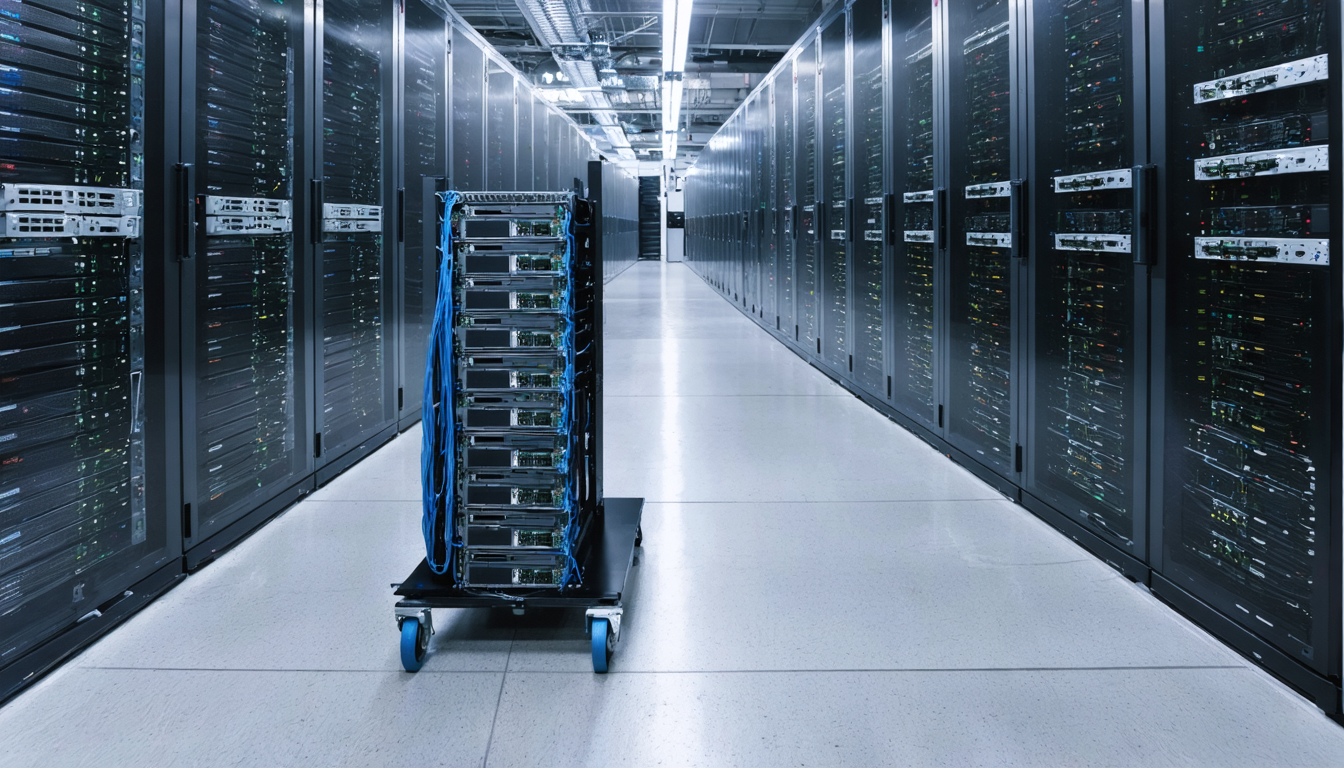
What happened
- Intel's venture arm, Oregon Venture Fund, Wellington Capital and IQT joined the round alongside several other investors.
- CEO Wilfred Gomes worked on die stacking at Intel, and CTO Jack Hwang helped develop the techniques Intel uses to etch transistors into silicon wafers.
- Oregon Venture Fund called Cubelets "Legos for the data center" in a blog post last year and said each module carries its own interconnect, power delivery and thermal equipment.
- The same blog post said Cubelet modules can host several chip types, including graphics cards and Arm CPUs.
Why it matters
- What it limits constraint Heat from the top of a stack has to cross other components to escape, so a peak efficiency figure tells a buyer little until it is measured under the heat a real workload produces.
- What it costs cost Mueon's software for running popular AI frameworks is still in development, so a pilot today would carry integration work on the buyer's side.
- Who's exposed exposure A team that sets power or cost targets from the 10x ceiling is building its plan on a number the vendor supplied.
Next story · Leadership · yesterday
Investors put $8M behind Othello's AI that tells sales reps what to say mid-callConfirmed4 publishers
The Cubelet pitch comes down to one number: up to 10 times more power- and cost-efficient than current hardware [15]. The ceiling is "up to", and power and cost share a single figure, so a buyer cannot tell how much of the gain lands on the electricity bill and how much on the purchase order. The SiliconANGLE report attributes the figure to the company and does not include a benchmark or a ship date [15].
The physics behind the claim is ordinary. Stacking puts components closer together, data travels a shorter distance, power use falls and computations speed up [12]. Cubelet applies that to compute and memory stacked atop one another instead of laid side by side on a motherboard [8]. Mueon says it will spend the money on more engineers and a better system design [5].
Heat is the hard part of stacking. Processors and memory often have different maximum operating temperatures, so a processor near its limit can overheat memory stacked on top of it [13]. In many servers a chip passes part of its heat to the motherboard. In a stack, heat from the top layer has to cross several other components first [14]. Oregon Venture Fund, an investor in the round, wrote last year that Mueon had found a way to handle this [16].
Gomes, the CEO, framed the product around density. "Mueon's architecture is built to move past today's rack-level constraints and deliver the kind of density the rest of the industry is only beginning to chart a path toward," Gomes said [11]. The company says Cubelets are optimized for AI and hyperscale workloads [10].
For those buyers we would ask for a measured result on their own workload before any capacity plan uses the 10x figure. The cost of that stance is time: if the claim holds, the teams that piloted early see it first.
Cross two questions: whether your workload is the one the company targets, and whether the vendor has a measured power and cost result on that workload under sustained load.
- Target workload, measured result in hand: run a pilot and compare it with current hardware. - Target workload, no measurement: ask for one and keep planning on current numbers. - Other workload, measured result: read it and check whether the design carries over. - Other workload, no measurement: no action yet.
What to watch
- A published benchmark, or a named customer pilot, showing measured power and cost on an AI workload.
- A technical description of how Cubelet handles heat from the top layer of the stack.
- Release of the software that lets customers run popular AI frameworks on Cubelet hardware.
Clarity's read
What the record supports and how the coverage leans. The claims behind it follow.
Reality
- Evidence30
- Adoption12
- Hype gap+40
- Incentives65
- Confidence72
Perspective Coverage
4 publishers- Builder
- Builder 38%
- Operator
- Operator 26%
- Investor
- Investor 36%
Claim ledger
Ranked by verification strength, evidence, and original report placement.
- [1]
Data center hardware startup Mueon Corp. announced that it has raised $65 million in funding.
- [2]
Semiconductor-focused fund Maverick Silicon led the Series A round.
- [3]
Maverick Silicon was joined in the round by Intel's venture capital arm, Oregon Venture Fund, Wellington Capital, IQT and several others.
- [4]
Mueon was founded last year by former Intel engineers Wilfred Gomes and Jack Hwang.
- [5]
Mueon will use the proceeds from the funding round to hire more engineers and improve its system design.
- [6]
Gomes, Mueon's CEO, worked on die stacking technologies at Intel; Hwang, the CTO, helped develop the techniques Intel uses to etch transistors into silicon wafers.
- [7]
In parallel, Mueon is developing software that will enable customers to run popular AI frameworks on its hardware.
- [8]
Mueon is developing a three-dimensional server architecture, Cubelet, that stacks computing and memory components atop one another, unlike a traditional server whose core components sit next to one another on a motherboard.
- [9]
In a blog post published last year, Oregon Venture Fund described Cubelets as "Legos for the data center" and stated that a Cubelet module includes computing and storage modules plus the auxiliary hardware they need to operate reliably, including interconnect, power delivery and thermal management equipment.
- [10]
Mueon stated that its Cubelets are optimized for artificial intelligence and hyperscale workloads.
- [11]
"Mueon's architecture is built to move past today's rack-level constraints and deliver the kind of density the rest of the industry is only beginning to chart a path toward," Gomes said.
- [12]
Stacked system designs pack server components closer together, which reduces the distance data must travel, lowers power use and speeds up computations.
- [13]
Processors and memory chips often have different maximum operating temperatures, so a processor operating near its maximum temperature can overheat memory modules stacked on top of it.
- [14]
In many servers chips dissipate part of their heat by channeling it to the motherboard; in 3D systems the heat from the top layer must go through multiple other components before it reaches the motherboard.
- [15]
According to the company, the Cubelet technology could prove to be up to 10 times more power- and cost-efficient than current hardware.
- [16]
Oregon Venture Fund's blog post last year stated that Mueon had found a way of addressing 3D systems' thermal management issues.
- [17]
The same blog post detailed that Cubelet modules can host multiple types of chips, including graphics cards and Arm central processing units.
Sources
3 independent publishers whose own reporting we read for this story.
- prnewswire.comMueon Raises $65M in Series A Funding to Scale its Cubelets™ Exponential Computing Platform
1 article · October 15, 2026
- runtimewire.comMueon raises $65M to validate modular AI data center systems
1 article · October 15, 2026
- siliconangle.comMueon nabs $65M in funding to develop 3D computing modules
1 article · October 15, 2026
- ventureburn.comMueon Raises $65M to Scale Modular AI Computing Systems.
1 article · October 15, 2026
Topics and entities
Topics
- Vertically stacked chips
- Startup Funding
- AI data-center hardware
Entities
- Oregon Venture Fund
- Intel Capital
- Maverick Silicon