CT scans of a braincase shelved since 1924 point to Europe's first megaraptoran
Cassius Morrison's team used CT scans of a 1924 museum braincase to name Invictibellatrix amberina, a possible first megaraptoran for Europe. It rests on one partial skull, so the European first depends on how that skull is classified.
The Scientist · Science desk
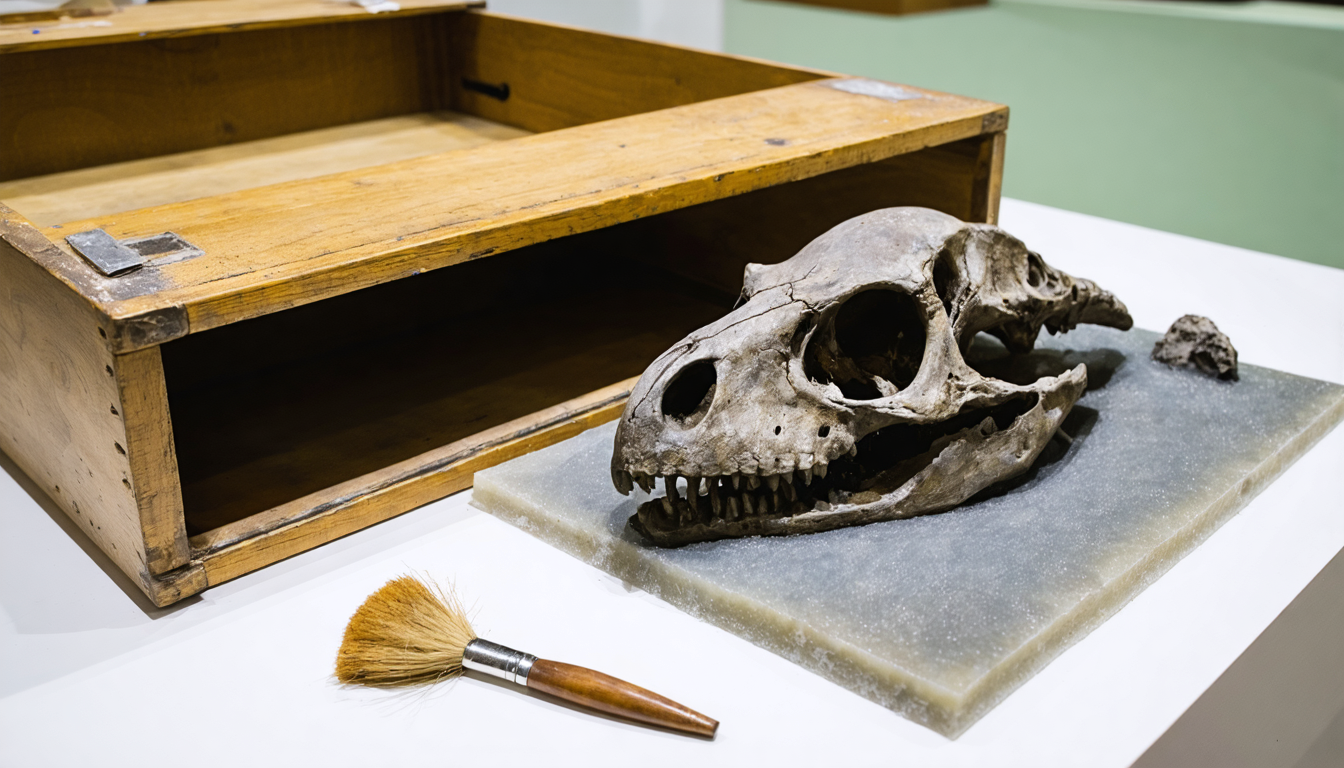
Three figures. The braincase was found in 120-million-year-old rocks. Morrison suggests megaraptorans dispersed from Asia into Europe some 130 million years ago. The closest match, the Argentinian megaraptoran Murusraptor, is from about 80 million years ago.
| Figure | Value | Note | Claim |
|---|---|---|---|
| Age of the rocks holding the braincase | 120 million years | 6 | |
| Dispersal from Asia into Europe, some, per Morrison | 130 million yrs ago | Morrison's suggested route | 15 |
| Murusraptor, the closest match, about | 80 million yrs ago | Argentinian megaraptoran | 5 |
What happened
- Morrison and colleagues built a 3D model of the fossil from CT scans and compared its features with those of other dinosaurs.
- The braincase was found in 120-million-year-old Lower Cretaceous rocks of the Wessex Formation on the south-west coast of the Isle of Wight.
- A similar-looking 5-metre dinosaur, Eotyrannus, lived in the same formation a few million years earlier, but no remains of the two individuals overlap, so they are hard to compare.
Why it matters
- What's now possible capability A European member would let the scattered Asian, Australian and South American finds be joined into a route. Morrison proposes Asia to Europe about 130 million years ago, then Africa, South America and Australia.
- What it limits constraint That route has one European data point, a partial braincase, so it stands or falls with where that single specimen is placed.
- What doesn't add up contradiction New Scientist notes Eotyrannus has been considered a megaraptoran relative, yet its known parts hint at a tyrannosaur sister group. If it were a megaraptoran, Europe's first would already be taken, so its placement bears on the headline claim.
Next story · Invest · yesterday
Nvidia's Huang says he would cut off an unsafe AI customer after a conversationConfirmed3 publishers
The identification rests on anatomical comparison. Murusraptor, the best match, is about 40 million years younger than the Isle of Wight rocks [9], and it comes from Argentina [5]. The researchers suggest the skull belongs to a new species within the Megaraptora [12].
Morrison also drew a picture of the living animal. He and his colleagues estimate an agile, two-legged carnivore 3 to 4 metres long, about 1.5 metres tall and 200 to 300 kilograms [10]. Morrison said it was likely to have had feathers and claws 10 to 20 centimetres long, suited to small dinosaurs, lizards and mammals [11]. New Scientist's report does not say how length and weight were estimated from the fossil.
Jake Kotevski at Monash University in Melbourne said it is a shame that more detailed comparisons with Eotyrannus could not be made [17]. He framed the larger payoff and the limit in the same breath. "If Invictibellatrix is indeed a megaraptoran, it expands the palaeobiogeographic range of the group and plugs a significant gap in our knowledge, linking those from South-East Asia to Australia and South America via Europe and Africa," Kotevski said [16]. He added: "However, more fossils are required to support or reject this hypothesis." [18]
The ancestors in Morrison's proposed route reach Europe about 10 million years before the rocks that hold the braincase [8]. The single European specimen therefore sits well after the arrival it is meant to illustrate.
The museum acquired the braincase in 1924 from a Reverend Reginald Hooley [1]. "It was sitting unstudied in the museum for about 100 years, which is very surreal," said Morrison, now at the University of Leeds [2].
What to watch
- Any Wessex Formation specimen with elements that overlap Eotyrannus, which would allow the direct comparison that is not possible now.
- Megaraptoran finds from Africa, the next stop on Morrison's proposed route out of Europe.
- Independent re-analyses of the braincase that test its placement within the Megaraptora.
Clarity's read
What the record supports and how the coverage leans. The claims behind it follow.
Reality
- Evidence62
- Adoption
- Not scored
- Hype gap+22
- Incentives40
- Confidence72
Perspective Coverage
7 publishers- Builder
- Builder 50%
- Operator
- Operator 36%
- Investor
- Investor 14%
Claim ledger
Ranked by verification strength, evidence, and original report placement.
- [1]
The fossil used to identify the species, a partial braincase, has been in the archives of the Natural History Museum in London since it was acquired from a Reverend Reginald Hooley in 1924.
- [2]
"It was sitting unstudied in the museum for about 100 years, which is very surreal," said Cassius Morrison, now at the University of Leeds, UK.
- [3]
Invictibellatrix amberina is a new species of predatory dinosaur, related to Tyrannosaurus rex, from the Isle of Wight in southern England.
- [4]
Morrison and his colleagues used CT scans to create a 3D scan of the fossil and compared it with features of other dinosaurs.
- [5]
The closest match was the Argentinian megaraptoran Murusraptor from about 80 million years ago.
- [6]
The skull was originally found in 120-million-year-old rocks from the Lower Cretaceous Wessex Formation on the south-west coast of the Isle of Wight.
- [7]
At the time, the Isle of Wight was still firmly attached to both mainland Britain and the rest of Europe, and the environment would have been subtropical, says Morrison.
- [8]
The proposed dispersal into Europe (some 130 million years ago) precedes the 120-million-year-old rocks that hold the braincase by about 10 million years.
- [9]
Murusraptor (about 80 million years ago) is about 40 million years younger than the Wessex Formation rocks (120 million years old).
- [10]
Morrison and colleagues estimate Invictibellatrix was an agile, two-legged carnivore about 3 to 4 metres long, some 1.5 metres tall and weighing between 200 and 300 kilograms.
- [11]
Morrison says Invictibellatrix is likely to have had feathers and claws 10 to 20 centimetres long for attacking small dinosaurs, lizards and mammals.
- [12]
The researchers suggest the skull is from a new species belonging to the Megaraptora group of carnivorous dinosaurs; if so, it is the first time a megaraptoran has been discovered in Europe.
- [13]
A similar-looking dinosaur, the 5-metre-long Eotyrannus, is known from a few million years earlier in the Wessex Formation, but the parts we have hint that it belonged to the sister group of tyrannosaurs, and none of the fossilised remains of the two individuals directly overlap, so it is hard to compare them.
- [14]
Megaraptoran fossils have been found in Asia, Australia and South America.
- [15]
Morrison suggests Invictibellatrix evolved from Asian megaraptorans that dispersed into Europe some 130 million years ago, after which megaraptorans spread from Europe to Africa, then to South America and Australia before the continents completely separated.
- [16]
"If Invictibellatrix is indeed a megaraptoran, it expands the palaeobiogeographic range of the group and plugs a significant gap in our knowledge, linking those from South-East Asia to Australia and South America via Europe and Africa," said Jake Kotevski of Monash University in Melbourne.
- [17]
Jake Kotevski at Monash University in Melbourne says it is a shame more detailed comparisons could not be made with Eotyrannus, which has previously been considered a relative of megaraptorans.
- [18]
"However, more fossils are required to support or reject this hypothesis," said Jake Kotevski.
Sources
6 independent publishers whose own reporting we read for this story.
- channelnewsasia.comIsle of Wight fossil sheds light on enigmatic meat-eating dinosaurs
1 article · October 13, 2026
- discovermagazine.comEurope’s First Known Megaraptoran Identified From a 120-Million-Year-Old Skull Hidden in a Museum Drawer
1 article · October 14, 2026
- independent.co.ukNew species of dinosaur discovered from fossil ‘overlooked’ for over 100 years | The Independent
1 article · October 13, 2026
- livescience.comFossil of 'unconquered female warrior' dinosaur with long claws found in UK museum drawer after 100 years
1 article · October 16, 2026
- newscientist.comDinosaur named new species 102 years after fossil found on Isle of Wight
1 article · October 13, 2026
- phys.orgIsle of Wight fossil Europe's first known long-clawed megaraptoran dinosaur
1 article · October 13, 2026
- sciencedaily.comA forgotten fossil reveals a fearsome dinosaur with giant claws
1 article · October 14, 2026
Topics and entities
Topics
- Museum fossil collections
- Evolutionary biogeography
- Paleontology
Entities
- Invictibellatrix amberina
- Royal Society Open Science
- Cassius Morrison
- University College London
- Natural History Museum, London