Google's orbital compute paper implies about 1,800 Starship launches in a decade
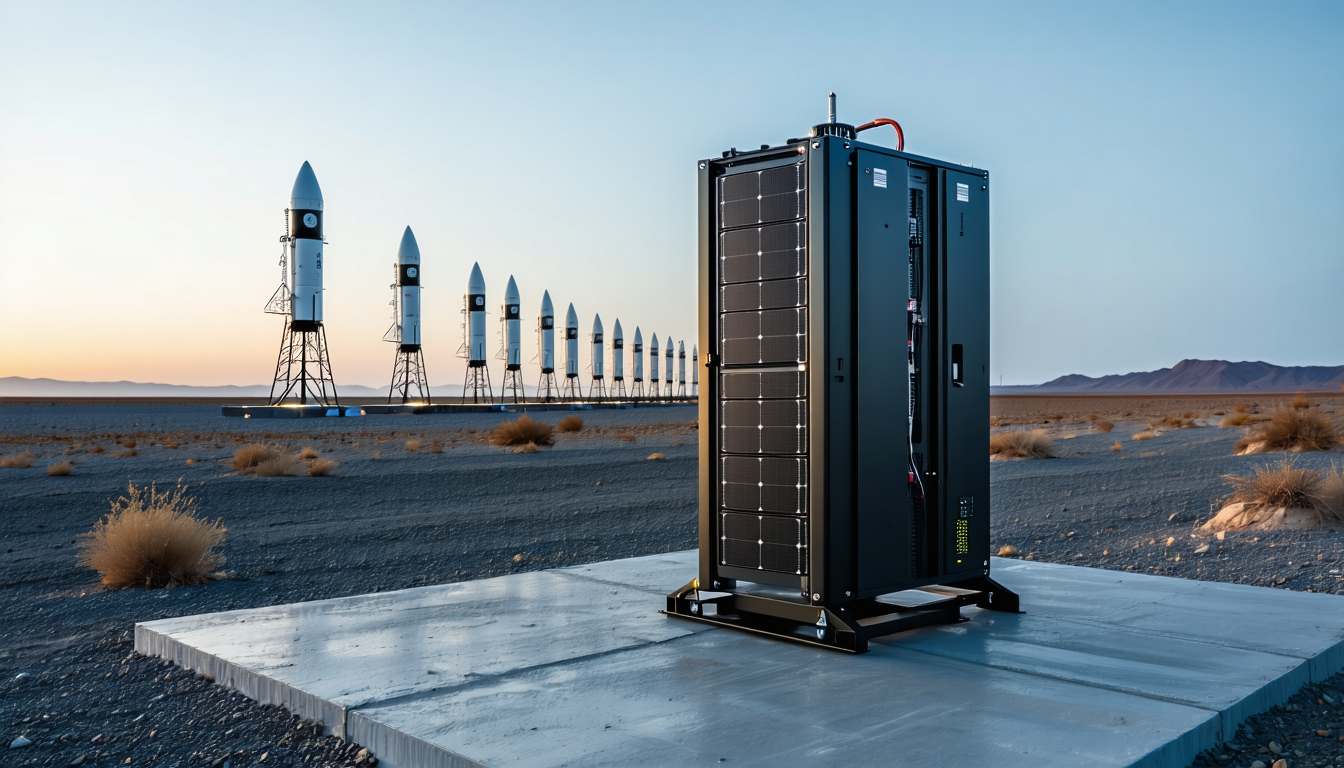
Google's orbital compute paper needs Starship to lift 370,000 tons to reach $200-a-kilogram launches, about 180 flights a year for a decade. Its first TPU in orbit will run in 15-minute bursts while Google tests whether a satellite can supply a kilowatt of steady power and keep the chip cool.
The Product Desk
What happened
- The paper's authors base their launch-price outlook on a learning curve of about 20% a year that they say SpaceX has held since Falcon 1.
- Starship, the vehicle that projection depends on, has never flown more than five times in a single year.
- Google is a major investor in SpaceX, the launch company its paper's price projections are built around.
- Google redid its radiation tests with less shielding, saw slightly more logic errors, and still expects its chips to handle inference over a five-year satellite life.
- Two more satellites, built for compute, are planned for 2027 to test the laser links needed to connect them.
Why it matters
- What it limits constraint Large training runs fall outside what this program is building toward, because Google's own error findings steer its orbiting chips to inference work.
- What it costs cost Every kilogram of radiator or shielding is paid for at whatever price Starship actually reaches, and the paper's $200 figure assumes a flight cadence the rocket has never come near.
- What doesn't add up contradiction Readers citing Google's estimate will differ by more than a year's worth of the paper's required flights, depending on which of TechCrunch's two figures they take.
- Who's exposed exposure Orbital compute sold on near-constant solar power is open to challenge on emissions, since Google's planned satellite life only reaches the low end of Fraire's breakeven range.
Next story · Invest · Oct 1
Google's first orbital TPU test puts one server's worth of chips on a SpaceX rideshareConfirmed4 publishers
A server hall uses air to carry heat off its chips. In orbit there is no air, so conventional cooling systems do not work, and any alternative adds weight that pushes up launch cost, Fast Company reported [26]. Google's experimental system lets the TPU work for around 15 minutes before it has to cool down [26]. "We've done testing on the ground, but you know, there's no test that's completely as good as the real thing," said Travis Beals, who manages Project Suncatcher at Google [10].
Google's stated goal is a network of 81 satellites flying in close formation and processing in parallel [5]. What went up is one TPU on a standard Planet Labs satellite [3]. Juan A. Fraire, a researcher at France's National Institute for Research in Digital Science and Technology, told Fast Company that laser connections are one of the biggest problems for any space data center [11]. Google has shown 800 Gbps links between optical transceivers in a lab, but reaching those speeds in orbit means flying satellites extraordinarily close together [11]. Holding that spacing takes maneuvers that burn propellant, and the propellant cannot be replenished [11].
The launch figures come from a peer-reviewed white paper Google released Thursday, due to be published in Joule. Its authors stress it is not an economic feasibility study [6]. To stay on SpaceX's price curve, they argue, Starship would have to carry 370,000 tons of payload to orbit [12]. TechCrunch puts that at about 1,800 launches over ten years, or 180 a year, if each flight carries 200 metric tons [13]. Divided out, 370,000 tons at 200 tons a flight is 1,850 launches [21]. TechCrunch's headline gives 1,600 [17], about 250 fewer than its own figures produce [24]. The 180-a-year pace is 36 times Starship's best year so far [22]. Elon Musk has suggested Starship could fly hourly in 2029 [15].
Beals drew the workload line himself. "The error rate is very low if you're thinking about typical inference operations, right? Like one in a million," Beals said. "On the other hand, it was already problematic for doing, say, some mega-scale training run where you're going to have many thousands of chips running for months." [9]
Lifespan is a separate test. Fraire's research suggests an orbital data center would need to run about five to six years to match the emissions of greener terrestrial facilities [16]. Google expects its satellites to last five years [8], the bottom of that range [23]. "I think we need to think before we act," Fraire told Fast Company. "And so far, we see the industry not thinking so much, but just acting." [19]
For an operator deciding where orbital compute could ever fit, two tests sort the candidates. One is whether a job can stop when the TPU's 15-minute burst ends without losing work [25]. The other is whether it tolerates an error rate near one in a million [9]. Short inference jobs pass both [8]. A months-long run across thousands of chips fails both [9].
On cost, the forcing question for anyone quoting orbital capacity is the launch price per kilogram behind the quote and the yearly flight rate that price assumes. Google's own path to about $200 a kilogram by 2035 needs roughly 180 Starship flights a year [7][13]. I'd keep orbital compute in a research budget until some rocket is flying near that rate. The tradeoff is timing. Matthew Weinzierl, author of the space-economics book Space to Grow, told Fast Company: "The costs of data centers on Earth are rising, while the costs of data centers in space will fall, and at some point those curves will cross." He went on: "We don't know when, but the big investments by Google, SpaceX and the like are intended to bring that day closer." [20]
What to watch
- The 2027 two-satellite demo, and whether its laser link gets near the 800 Gbps Google has shown in the lab without burning through propellant.
- Starship's annual flight count, measured against the roughly 180 a year the paper's price curve needs.
- Whether Google lengthens the TPU's 15-minute run time after commissioning and publishes in-orbit error results.
Clarity's read
What the record supports and how the coverage leans. The claims behind it follow.
Reality
- Evidence72
- Adoption8
- Hype gap+22
- Incentives62
- Confidence68
Perspective Coverage
6 publishers- Builder
- Builder 40%
- Operator
- Operator 31%
- Investor
- Investor 29%
Claim ledger
Ranked by verification strength, evidence, and original report placement.
- [1]
Google's prototype orbital compute satellite launched on a SpaceX rocket from California, the first time Google has sent one of its advanced chips (a Tensor Processing Unit) into space.
- [2]
Two more satellites are planned for 2027 to test the laser links needed to connect them.
- [3]
The satellite was built by Planet Labs and is based on a standard Planet Labs platform.
- [4]
The satellite is meant to prove a Google TPU can function in space, which means supplying a kilowatt of continuous power, cooling the chip, and running models to see if anything goes wrong.
- [5]
Google envisions a network of 81 satellites flying in close formation, processing in parallel.
- [6]
On Thursday Google released a peer-reviewed version of its white paper on orbital data centers, to be published in Joule; the researchers stress the analysis isn't an economic feasibility study.
- [7]
The paper's authors argue SpaceX has achieved a price-reducing learning curve of about 20% a year since Falcon 1 and that it is reasonable to expect launch prices close to $200 per kilogram by 2035.
- [8]
Google redid particle-accelerator radiation tests after realizing the chip configuration provided more shielding than it would experience in space; this produced slightly more logic errors, but Google is still confident its chips can handle large inference workloads in orbit for a satellite's five-year lifespan.
- [9]
"The error rate is very low if you're thinking about typical inference operations, right? Like one in a million," Beals said. "On the other hand, it was already problematic for doing, say, some mega-scale training run where you're going to have many thousands of chips running for months."
- [10]
"We've done testing on the ground, but you know, there's no test that's completely as good as the real thing," said Travis Beals, the Google executive managing Project Suncatcher.
- [11]
Juan A. Fraire, a researcher at France's National Institute for Research in Digital Science and Technology, says laser connections are one of the biggest challenges for space data centers; Google has demonstrated 800 Gbps connections between optical transceivers in the lab, but reaching those speeds in orbit requires satellites to fly extraordinarily close together, and keeping them close requires maneuvers that burn propellant which can't be replenished.
- [12]
Based on Falcon 9 payload history, the authors think a similar cost-reduction trajectory will require Starship to fly 370,000 tons of payload into orbit.
- [13]
That would take Starship about 1,800 launches over the next ten years, or 180 a year, if it can fly 200 metric tons on each mission.
- [14]
Starship has never flown more than five times in a year.
- [15]
Elon Musk has suggested Starship could achieve an hourly flight rate in 2029.
- [16]
Fraire's research suggests orbital data centers would need to operate for around five to six years to match the emissions profile of greener terrestrial facilities.
- [17]
TechCrunch's headline states that Google thinks Starship has to launch 1,600 times before space data centers get off the ground.
- [18]
Google is a major investor in SpaceX and, like other data center companies, is looking to SpaceX to launch its spacecraft.
- [19]
"I think we need to think before we act," Fraire said. "And so far, we see the industry not thinking so much, but just acting."
- [20]
"The costs of data centers on Earth are rising, while the costs of data centers in space will fall, and at some point those curves will cross," said Matthew Weinzierl, author of Space to Grow. "We don't know when, but the big investments by Google, SpaceX and the like are intended to bring that day closer."
- [21]
370,000 tons of payload at 200 metric tons per flight is 1,850 Starship launches.
- [22]
A pace of 180 Starship flights a year is 36 times the most Starship has flown in a single year.
- [23]
Google's planned five-year satellite lifespan equals the low end of Fraire's five-to-six-year emissions breakeven range for orbital data centers.
- [24]
TechCrunch's 1,600-launch headline figure is about 250 launches below the 1,850 its reported tonnage and per-flight payload produce.
- [25]
Once commissioned, the satellite will fire up its TPU in 15-minute bursts to avoid straining its power and thermal management systems.
- [26]
Cooling is a familiar problem for terrestrial data centers that becomes harder in space: without air to carry heat away, conventional cooling systems won't work, any alternative adds weight and increases launch costs, and Google's current experimental system lets its chips operate for around 15 minutes before they need to cool down.
Sources
6 independent publishers whose own reporting we read for this story.
- blog.googleOur Project Suncatcher prototype satellite is in orbit.
1 article · October 1, 2026
- dev.toGoogle’s Project Suncatcher Reaches Orbit to Test Space-Based AI Compute
1 article · October 2, 2026
- fastcompany.comGoogle is taking Elon Musk’s space data center idea seriously
1 article · October 1, 2026
- mezha.netSpaceX вивела на орбіту супутник із тензорним чипом Google
2 articles · October 2, 2026
- runtimewire.comGoogle puts four TPUs in orbit to test its space-compute plan
1 article · October 1, 2026
- techcrunch.comGoogle thinks SpaceX’s Starship has to launch 1,600 times before space data centers get off the ground
1 article · October 1, 2026
Topics and entities
Topics
- Orbital data centers
- AI Accelerators
- Launch economics