Fourteen tail vertebrae from Teruel put Diplodocus in Europe for the first time
Paleontologists at Fundación Dinópolis have assigned a partial tail from El Castellar, Spain, to Diplodocus, a genus known until now only from the Morrison Formation. Its closest known relative is a Morrison species.
The Scientist · Science desk
What happened
- Researchers from the Fundación Conjunto Paleontológico de Teruel-Dinópolis report in the Journal of Vertebrate Paleontology the first evidence of Diplodocus found outside North America.
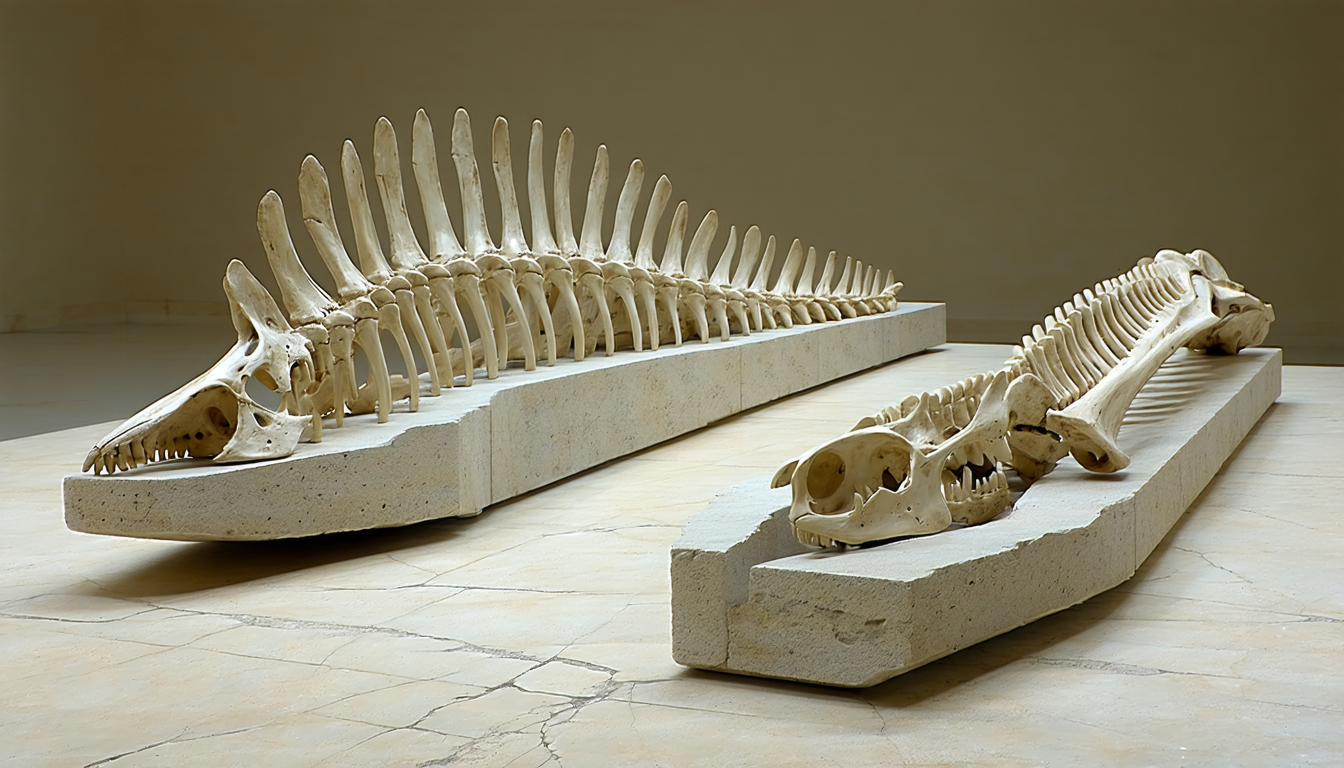
- The material is 14 well-preserved caudal vertebrae and several chevron bones, dug out over time at the La Tejería site in El Castellar, Teruel, in eastern Spain.
- Every confirmed Diplodocus specimen before this one came from a single unit, the Morrison Formation of the western United States.
- Co-author Alberto Cobos, managing director of Fundación Dinópolis, said the El Castellar animal was about 25 metres long, comparable in size to its North American relatives.
- The bones are now in the dinosaur hall of the Museo Aragonés de Paleontología at Dinópolis in Teruel, available for study and public viewing.
Why it matters
- What it limits constraint One partial tail from one site records a presence in Iberia at the end of the Jurassic. Which way animals crossed the proto-Atlantic, and how many times, is not something a single specimen can decide.
- What's now possible capability European Jurassic sauropod work now has a genus shared with the Morrison Formation, so Iberian diplodocid material can be compared against a North American standard instead of being left at family level.
- What it sets up precedent Because the diagnosis runs on caudal and chevron characters, museum drawers holding isolated diplodocid tails elsewhere in Europe become candidates for the same test.
- What doesn't add up contradiction The paper calls a partial tail one of the most complete diplodocid skeletons in Europe. That caps how much comparative material any reviewer of the claim has to work with.
Next story · Science · 4d ago
Ctenosuchus, a Jurassic crocodile relative from Morocco, had teeth too thin for large preyConfirmed2 publishers
The assignment rests on four features of the tail bones: large pneumatic cavities in the vertebrae, deep longitudinal grooves along their undersides, forked chevrons with distinctive medial fossae, and elongated centra without lateral ridges [4]. Anatomical comparison on its own leaves room to argue. So the team also ran two phylogenetic analyses that make different assumptions about how character change accumulates, maximum parsimony and Bayesian inference, and both placed the specimen inside Diplodocus as a close relative of Diplodocus hallorum [5]. "Then, as we carried out different evolutionary analyses, they kept pointing in the same direction," said Sergio Sanchez Fenollosa, the Fundación Dinópolis doctoral student who led the study [12].
The sister-taxon result is what makes this more than a range extension. Diplodocus hallorum is itself known from Morrison material [17], so the closest relative of an Iberian animal sits in the western United States. The paper's explanation is geography: dinosaurs could move between the two continents in the Late Jurassic, most likely over temporary land bridges exposed when the proto-North Atlantic went through regressive phases [9]. The Spanish specimen dates to roughly 150 million years ago [6].
Sanchez Fenollosa said: "And what is more, the outcome of the dig is some of the strongest paleontological evidence for episodes of dispersal and faunal exchange between the two continents across the proto-Atlantic Ocean during the Late Jurassic" [8]. The land bridges themselves come from the sea-level record [9].
The authors call this partial tail one of the most complete diplodocid skeletons ever found in Europe [7]. Fourteen vertebrae and some chevrons clearing that bar is a measure of how little diplodocid material Europe has produced.
Diplodocus has been known from American bones since 1878 [11]. The report confirming it on a second continent is dated September 2026 [14], about 148 years later [16].
What to watch
- Whether an independent reanalysis of the character matrix keeps the El Castellar specimen inside Diplodocus or moves it to a broader diplodocine position.
- Whether further digging at La Tejería yields more of the skeleton, including material outside the tail.
- Whether isolated diplodocid tail material already in European collections gets reassigned to Diplodocus on the same characters.
Clarity's read
What the record supports and how the coverage leans. The claims behind it follow.
Reality
- Evidence72
- Adoption
- Not scored
- Hype gap+20
- Incentives55
- Confidence70
Perspective Coverage
3 publishers- Builder
- Builder 51%
- Operator
- Operator 27%
- Investor
- Investor 22%
Claim ledger
Ranked by verification strength, evidence, and original report placement.
- [1]
Paleontologists from the Fundación Conjunto Paleontológico de Teruel-Dinópolis identified the first evidence of Diplodocus outside North America, detailed in the Journal of Vertebrate Paleontology.
- [2]
The fossil was unearthed at the La Tejería site in El Castellar, Teruel, Spain, where a Fundación Dinópolis team excavated 14 exceptionally preserved caudal (tail) vertebrae and several chevron bones over time.
- [3]
Until this study, all confirmed Diplodocus specimens had come exclusively from the Morrison Formation in the western United States.
- [4]
The preservation allowed researchers to identify features characteristic of Diplodocus: large pneumatic cavities in the vertebrae, deep longitudinal grooves on the underside of the tail bones, distinctive forked chevron bones with unique medial fossae, and elongated vertebral centra without lateral ridges.
- [5]
Using traditional anatomical comparisons and phylogenetic analyses including maximum parsimony and Bayesian inference, the team placed the specimen within the genus Diplodocus, specifically as a close relative of Diplodocus hallorum.
- [6]
The Spanish Diplodocus dates to approximately 150 million years ago, at the end of the Jurassic Period.
- [7]
The find represents one of the most complete diplodocid skeletons ever discovered in Europe.
- [8]
"And what is more, the outcome of the dig is some of the strongest paleontological evidence for episodes of dispersal and faunal exchange between the two continents across the proto-Atlantic Ocean during the Late Jurassic."
- [9]
Its presence in Europe provides evidence that dinosaurs could migrate between North America and Europe during the Late Jurassic, likely crossing temporary land bridges that emerged as the proto-North Atlantic Ocean underwent regressive phases.
- [10]
Co-author Dr. Alberto Cobos, managing director of Fundación Dinópolis, said the Diplodocus from El Castellar was approximately 25 meters long, comparable in size to its North American relatives, making it another of the giant sauropods of the Spanish Jurassic.
- [11]
Diplodocus was discovered in the United States in 1878, and casts of its skeletons were displayed in leading natural history museums through the early 20th century.
- [12]
"Then, as we carried out different evolutionary analyses, they kept pointing in the same direction."
- [13]
The fossils are on display for research and public education in the dinosaur hall of the Museo Aragonés de Paleontología at Dinópolis in Teruel.
- [14]
The phys.org report on the discovery is dated September 2026 and says the article was detailed that day.
- [15]
Cobos placed the new specimen alongside other Teruel sauropods with characteristics very different from those of diplodocids, such as Turiasaurus and Losillasaurus.
- [16]
About 148 years separate the 1878 discovery of Diplodocus in the United States from the September 2026 report confirming the genus outside North America.
- [17]
Diplodocus hallorum, named as the El Castellar animal's close relative, is known from Morrison Formation material.
Sources
3 independent publishers whose own reporting we read for this story.
- discovermagazine.com150-Million-Year-Old Tail Bones Found in Spain Reveal the First <em>Diplodocus</em> Outside North America
1 article · September 15, 2026
- livescience.comFossils of iconic long-necked dinosaur Diplodocus found in Europe for first time — and it may have traveled there via land bridge
1 article · September 15, 2026
- phys.orgFirst confirmed Diplodocus outside North America reshapes Late Jurassic migration picture
1 article · September 14, 2026
Topics and entities
Topics
- Dinosaur biogeography
- Vertebrate Paleontology
- Phylogenetic analysis
Entities
- Josué García Cobeña
- Diplodocus hallorum
- Sergio Sánchez Fenollosa
- Museo Aragonés de Paleontología
- Fundación Conjunto Paleontológico de Teruel-Dinópolis
- Journal of Vertebrate Paleontology
- Morrison Formation