New fungus Dianjunus rex, up to 50 cm tall, is largest known ascomycete fruiting body
Kunming Institute of Botany researchers describe Dianjunus rex, a Yunnan fungus up to 50 cm tall and 2.2 kg, the largest known ascomycete. Corresponding author Indunil Senanayake says the new family it founds, Dianjunaceae, shows how much East Asian fungal diversity is undescribed.
The Scientist · Science desk
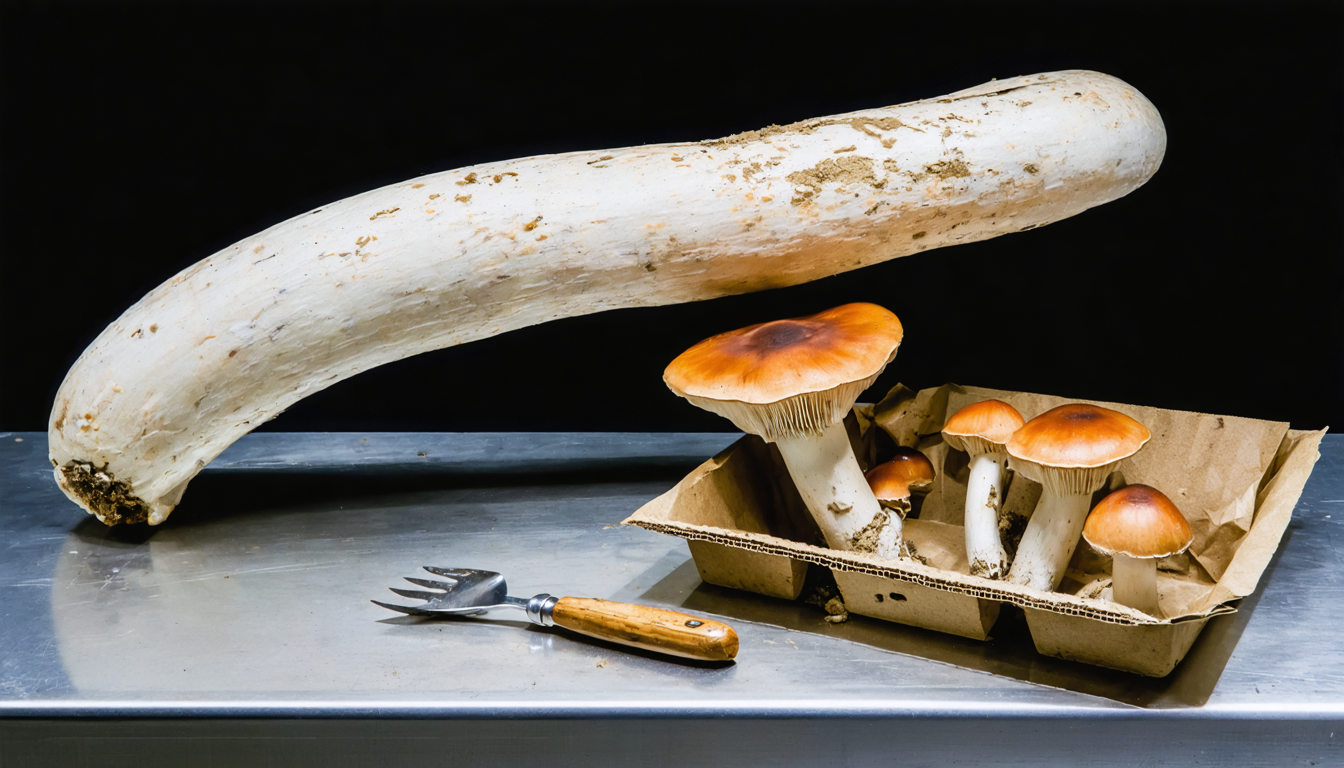
Dianjunus rex fruiting bodies reach up to 50 cm tall. Earlier record-holding ascomycete fruiting bodies measured 20 to 30 cm tall. Dianjunus rex fruiting bodies weigh up to 2.2 kg.
| Figure | Value | Note | Claim |
|---|---|---|---|
| Dianjunus rex fruiting body height, up to | 50 cm | 1 | |
| Earlier ascomycete record-holders' height, at least | 20 cm | up to 30 cm | 2 |
| D. rex weight, up to | 2.2 kg | 1 |
What happened
- Fruiting bodies turned up near Damaidi and Yipinglang in temperate coniferous forest and near Nanbang in tropical rainforest.
- The team deposited voucher specimens at the Kunming Institute of Botany, grew spores on media to study morphology, and sequenced the genome, including its protein-coding genes.
- The closest known relative is Graphostroma platystoma, a fungus found on dead hardwood throughout the Northern Hemisphere and the only member of its family, Graphostromataceae.
- A molecular clock analysis against hundreds of fungi of known age puts the origin of Dianjunaceae at around 65 million years ago, one million years after the end-Cretaceous extinction.
Why it matters
- What it limits constraint The 50 cm and 2.2 kg figures are stated as 'up to' values, so the record is a ceiling and a typical fruiting body is smaller.
- What's now possible capability Voucher specimens in the Kunming Institute of Botany collections give other taxonomists physical material for checking the family placement.
- What it sets up precedent The authors predict more fungal discoveries from subtropical China, so further new names from the region are the stated expectation.
Next story · Science · 5h ago
Baker lab's from-scratch zinc proteases cut their chosen target in 36% of 135 designsConfirmed2 publishers
Earlier record-holders among ascomycete fruiting bodies measured 20 to 30 cm tall [2]. A 50 cm maximum is about 1.7 to 2.5 times that [11]. Ascomycetes are the largest group of fungi, with more than 64,000 species [9]. They do not grow true mushrooms. They release spores from tiny sac-like structures inside or on the surface of fruiting bodies [9].
The new fungus grew from woody roots of Chinese cork oak, emerging from the rhizosphere [13]. Genetic results, confirmed by a detailed study of its morphology, placed it in a new species, a new genus and a new family within the order Xylariales [3]. Xylariales are known for secondary compounds and for enzymes that break down complex plant molecules, and phys.org's account says such enzymes might help D-rex digest dead wood [14].
Senanayake, corresponding author of the paper in Frontiers in Fungal Biology, presented the link to the mass extinction as a possibility [4]. "This timing raises an intriguing possibility. After the mass extinction, forests experienced dramatic changes, including the sudden availability of large amounts of dead plant material," Senanayake said [16]. The clock analysis dates the origin but does not test a cause.
He also offered a hypothesis for the height. "A fruiting body which towers above surrounding vegetation and debris could have better dispersal of spores by wind in dense forests. However, such a large structure requires substantial energy investment, suggesting that this strategy likely evolved only where the ecological benefits outweighed the costs," he said [17].
The broader claim rests on the thinnest evidence. "The discovery illustrates how much fungus biodiversity remains to be discovered in East Asian forests," Senanayake said [7]. He gave reasons the region has been under-counted: "Historically, however, fungal diversity in these ecosystems has been underestimated due to logistical difficulties in field sampling, the seasonal and cryptic nature of fungal fruiting, and a historical emphasis on economically important fungi" [8].
The account describes one new family, from fieldwork at three named localities [15]. A fruiting body this size, the largest known in its phylum, had gone undescribed until now [1]. We think that supports the undersampling account and the authors' expectation of more finds [18].
What to watch
- Further Xylariales described from subtropical China, which would test the authors' prediction of more finds.
- Spore-dispersal measurements on tall versus shorter ascomycete fruiting bodies, which would test the wind-dispersal explanation for the height.
- More collected specimens of D. rex, which would show whether 50 cm and 2.2 kg are typical or exceptional.
Clarity's read
What the record supports and how the coverage leans. The claims behind it follow.
Reality
- Evidence72
- Adoption
- Not scored
- Hype gap+15
- Incentives
- Not scored
- Confidence70
Perspective Coverage
5 publishers- Builder
- Builder 65%
- Operator
- Operator 21%
- Investor
- Investor 14%
Claim ledger
Ranked by verification strength, evidence, and original report placement.
- [1]
Dianjunus rex produces vertical fruiting bodies up to 50 cm high and weighing up to 2.2 kg, the largest known within the phylum Ascomycota.
- [2]
Until now, the record-holders among ascomycete fruiting bodies measured 20 to 30 cm tall.
- [3]
Genetic results confirmed by a detailed study of morphology showed the fungus is a new species, a new genus and a new family (Dianjunaceae) within the order Xylariales.
- [4]
Dr. Indunil C. Senanayake, associate professor at the Germplasm Bank of Wild Species of the Kunming Institute of Botany, is corresponding author of the study published in Frontiers in Fungal Biology.
- [5]
The closest known relative of D-rex is Graphostroma platystoma, which grows on dead hardwood across the Northern Hemisphere and by itself forms the family Graphostromataceae.
- [6]
A molecular clock analysis comparing the new species' DNA with the genomes of hundreds of fungi of known evolutionary ages estimated that Dianjunaceae arose around 65 million years ago, one million years after the Cretaceous-Paleogene mass extinction.
- [7]
"The discovery illustrates how much fungus biodiversity remains to be discovered in East Asian forests."
- [8]
"Historically, however, fungal diversity in these ecosystems has been underestimated due to logistical difficulties in field sampling, the seasonal and cryptic nature of fungal fruiting, and a historical emphasis on economically important fungi," said Senanayake.
- [9]
Ascomycetes, the largest group of fungi with more than 64,000 species, do not grow true mushrooms but release spores from tiny sac-like structures inside or on the surface of fruiting bodies.
- [10]
The scientists collected the fruiting bodies, deposited voucher specimens in the collections of the Kunming Institute of Botany, grew spores on media to study morphology, and sequenced the fungus's genome, including its protein-coding genes.
- [11]
A 50 cm maximum height is about 1.7 to 2.5 times the earlier record heights of 30 cm and 20 cm.
- [12]
Fruiting bodies were found during fieldwork in temperate coniferous forests near Damaidi and Yipinglang and in tropical rainforest near Nanbang.
- [13]
The fruiting bodies grew on woody roots of Chinese cork oak, emerging from the rhizosphere.
- [14]
Xylariales are known for producing secondary compounds and enzymes that can degrade complex plant molecules; such enzymes might likewise help D-rex digest dead wood.
- [15]
The fieldwork was at three named localities: Damaidi, Yipinglang and Nanbang.
- [16]
"This timing raises an intriguing possibility. After the mass extinction, forests experienced dramatic changes, including the sudden availability of large amounts of dead plant material," said Senanayake.
- [17]
"A fruiting body which towers above surrounding vegetation and debris could have better dispersal of spores by wind in dense forests. However, such a large structure requires substantial energy investment, suggesting that this strategy likely evolved only where the ecological benefits outweighed the costs," hypothesized Senanayake.
- [18]
The researchers predicted that more discoveries of fungi from subtropical China lie in store.
Sources
5 independent publishers whose own reporting we read for this story.
- discovermagazine.comMeet D-Rex, a Newly Discovered 5-Pound Fungus With a 65-Million-Year-Old Lineage
1 article · October 14, 2026
- gizmodo.comMeet ‘D. Rex,’ the Monster Fungus Born in the Wake of the Dinosaur Apocalypse
1 article · October 15, 2026
- phys.orgScientists discover 'D-rex', a giant fungus from Chinese forests whose unique lineage dates back 65 million years
1 article · October 13, 2026
- popsci.comWhen ‘T. rex’ died, a new giant fungus named ‘D-rex’ took over
1 article · October 14, 2026
- sciencealert.comScientists Uncover D. Rex: Gigantic New 'King' Fungus From China Traces Its Roots to 65 Million Years
1 article · October 15, 2026
Topics and entities
Topics
- Yunnan biodiversity
- Cretaceous-Paleogene extinction
Entities
- Kunming Institute of Botany
- Frontiers in Fungal Biology
- Indunil C. Senanayake
- Graphostroma platystoma