BYD's export growth covers barely two-thirds of the revenue it lost at home
Overseas revenue added about $6.9bn while Greater China shed roughly $10.8bn, so the group shrank even as exports grew a third, and Citi's 41.2 billion yuan full-year figure now needs a second half 2.35 times the first.
The Investor · Invest desk
What happened
- BYD shares fell nearly 5% in Hong Kong on Monday, the first trading session after the automaker released its interim results on Friday.
- Overseas revenue rose 34% to $27 billion and passed half of total sales, while revenue inside Greater China fell 31%.
- Exports rose 67.8% year on year to 792,000 vehicles in the first half, the volume engine behind the overseas revenue line.
Why it matters
- What it limits constraint Because exports covered only about 64 cents of each dollar of domestic revenue lost, BYD can grow its overseas book by a third and still shrink as a group, which caps what volume leadership does for the income statement.
- Who's exposed exposure Citi's 41.2 billion yuan full-year number leans on 28.9 billion in the second half, 2.35 times the first, so the shares are exposed to one sequential margin assumption rather than to reported results.
- Who has to decide decision Freight, tariff exposure and Denza's European premium build are absorbing capital that is not going into defending domestic share on price, which is the choice the 31% decline puts on the table.
- What doesn't add up contradiction BYD's home revenue fell harder than the German four's did in China, which makes it awkward to read the price war as something the local champion is winning at the incumbents' expense.
Next story · Product · 2d ago
US EV sales in the latest quarter sit about 174,000 units below the Q3 2025 rushConfirmed2 publishers
Back out the quarters and the half-year reads as an average of two unlike ones. Net profit attributable to shareholders was 12.3 billion yuan for the six months [3], 8.2 billion of it in the second quarter on Citi's reading [6], which leaves 4.1 billion for the first [20]; and because the minus 20.5% and plus 30% comparisons imply a prior-year half near 15.5 billion and a prior-year second quarter near 6.3 billion, the year-earlier first quarter sat around 9.2 billion, putting BYD's Q1 profit decline at roughly 55% [21]. Revenue moved the same way, 150.2 billion yuan in Q1 against about 170.6 billion a year earlier, down some 12% where Q2 fell only 3% [23] [7]. Net margin ran 2.7% and then 4.2% [26].
The more useful arithmetic, or rather the version that explains Monday, is on the mix. If the half totalled about $51 billion after a 7.1% fall [4] [2], the prior-year half was near $54.9 billion; if overseas was $27 billion after 34% growth [5], the prior-year overseas was near $20.1 billion, which leaves domestic at roughly $34.8 billion then and $24 billion now [24]. The home market shed about $10.8 billion while the export book added about $6.9 billion, so overseas growth replaced 64 cents of every dollar lost in China [24]. Overseas is now 52.9% of sales [18], a first for the company [10], and that milestone is as much subtraction as addition.
One caution on the $27 billion: divide it by the 792,000 vehicles exported [8] and you get about $34,100 a unit [19], which is not a car price, so the overseas line carries considerably more than exported vehicles and neither publisher breaks out how much.
What is holding the equity up is Citi's full-year net profit of 41.2 billion yuan, described as potentially 8% above consensus [12]. Against 12.3 billion already booked, that asks for 28.9 billion in the second half, 2.35 times the first [25]. Citi's 13.5 billion Q3 core-earnings figure [12] is a different measure from net profit, so it is not the same test. The mix lever behind it is real enough: Fangchengbao, Denza and Yangwang grew 61% to 12.8% of group passenger-vehicle sales [13].
Domestic pricing could settle, premium mix could carry margin, and the 2.35 could happen [25]. Or exports keep compounding off 67.8% growth [8] straight into European protectionism, tariffs and freight [16], and the replacement ratio stays below one. Or the domestic drop is largely a comparison against subsidised volume and reverts. This is probably wrong, but the last of those looks weakest, because BYD's own 31% Greater China decline [11] is steeper than the more-than-20% first-half China revenue falls at Volkswagen, Mercedes-Benz, BMW and Porsche [15] [27], and the company itself pointed at sluggish domestic demand alongside commodity and chip costs [9]. A price war that takes a third of the local champion's home revenue is evidence that the whole market is contracting, with BYD losing ground at home right alongside the incumbents it is supposedly beating.
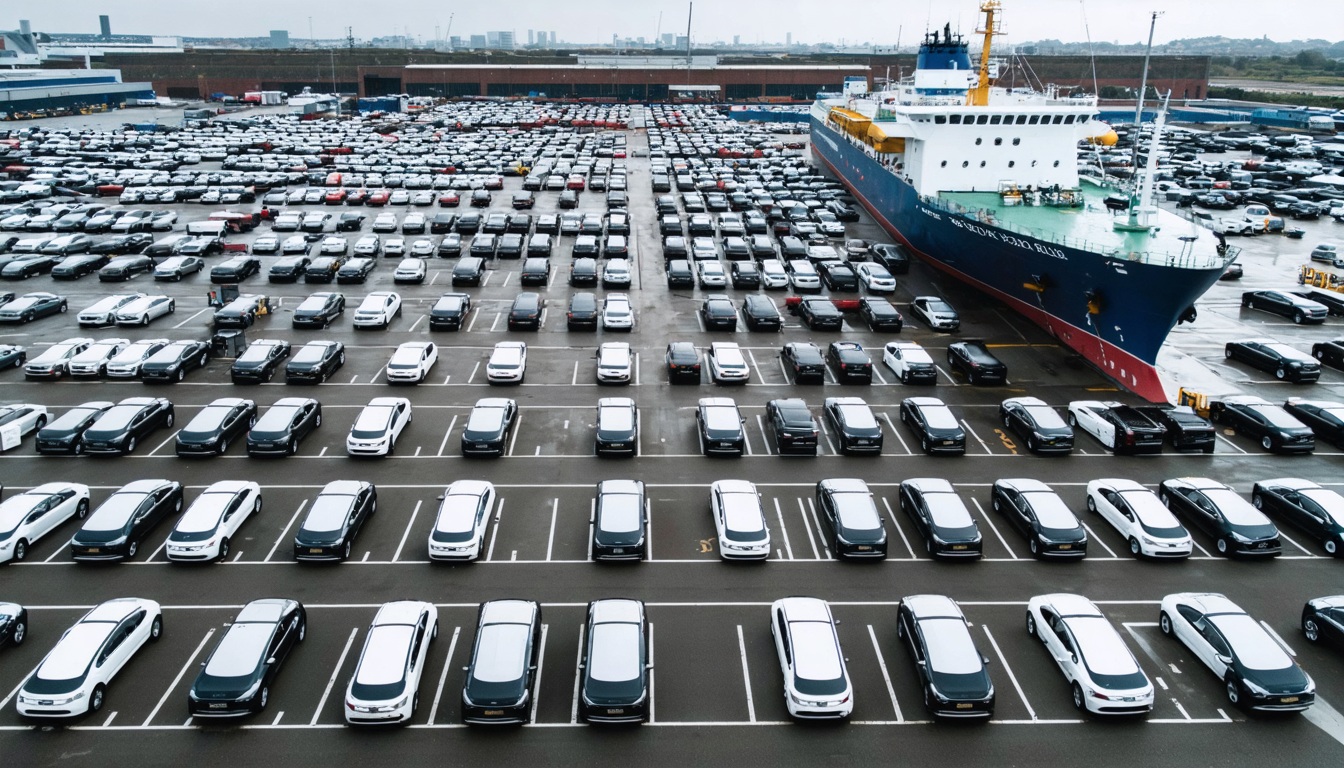
Note where the money is going meanwhile: into Denza's European premium build [17] and the shipping and tariff bill attached to those 792,000 units [16], rather than into buying domestic share back on price. BYD did outsell Tesla on first-half EV volume [28]. If the second half repeats the first, though, the group contracts about 7% again while its overseas line grows a third [2] [5], which describes a company converting a home market into a logistics business at 64 cents on the dollar [24].
What to watch
- Whether BYD's next filing splits the overseas revenue line into vehicles and other segments, which would settle what the $34,100-per-export figure actually contains.
- Whether the Greater China revenue decline narrows from 31% in the third quarter, or holds, which is the difference between a comparison effect and structural erosion.
- Whether European tariff and regulatory decisions change the landed economics on the 792,000-unit export run rate.
Information, not investment advice. This story is general information about companies and markets, drawn from cited reporting. It is not a recommendation to buy, sell or hold any security; check the cited sources before acting.
Clarity's read
What the record supports and how the coverage leans. The claims behind it follow.
Reality
- Evidence70
- Adoption68
- Hype gap+15
- Incentives
- Not scored
- Confidence64
Claim ledger
Ranked by verification strength, evidence, and original report placement.
- [1]
BYD shares fell nearly 5% in Hong Kong on Monday, following the release of its interim results on Friday.
- [2]
For the first half, BYD reported revenue of 344.8 billion yuan, down 7.1% from a year earlier.
- [3]
First-half net profit attributable to BYD shareholders fell 20.5% to 12.3 billion yuan, according to the company.
- [4]
BYD's first-half revenue of 344.8 billion yuan is equivalent to about $51 billion, and net profit of 12.3 billion yuan to about $1.8 billion.
- [5]
BYD's overseas revenue jumped 34% to $27 billion in the first half, representing more than 50% of its total business.
- [6]
BYD's second-quarter net profit was 8.2 billion yuan ($1.2 billion), up 30% from a year earlier, according to Citi following the results.
- [7]
BYD's second-quarter revenue fell 3% year on year to 194.6 billion yuan, according to Citi.
- [8]
BYD's exports rose 67.8% year on year to 792,000 vehicles in the first half.
- [9]
BYD said China's auto industry faced sluggish domestic demand and robust export growth in the first half, while fierce competition and rising costs for commodities, raw materials and chips squeezed automakers' profit margins.
- [10]
Overseas revenue made up the majority of BYD's first-half sales for the first time.
- [11]
BYD's international expansion cushioned a 31% revenue decline inside Greater China.
- [12]
Citi expects BYD's third-quarter core earnings to reach 13.5 billion yuan and sees full-year net profit of 41.2 billion yuan, potentially coming in 8% above consensus.
- [13]
In China, combined sales of BYD brands including FANGCHENGBAO, Denza and Yangwang grew 61% year on year, accounting for 12.8% of the group's passenger vehicle sales.
- [14]
Second-quarter Chinese sales at Volkswagen, Mercedes-Benz, BMW and Porsche fell between 30% and 41% year over year.
- [15]
All of Volkswagen, Mercedes-Benz, BMW and Porsche suffered a year-on-year drop in Chinese revenue of more than 20% during the first half.
- [16]
BYD faces higher shipping costs, trade barriers, tariffs and regulatory scrutiny, as Europe introduces protectionist policies designed to shield its domestic automotive sector from Chinese competition.
- [17]
BYD is betting on its Denza brand to establish a stronger presence in Europe's premium market and counter price competition in China.
- [18]
Overseas revenue was about 52.9% of BYD's first-half sales.
- [19]
Dividing the $27bn overseas revenue by 792,000 exported vehicles gives about $34,100 per unit.
- [20]
BYD's first-quarter net profit attributable to shareholders was 4.1 billion yuan.
- [21]
The prior-year first half implies about 15.5 billion yuan of net profit and the prior-year second quarter about 6.3 billion, leaving roughly 9.2 billion for the year-earlier first quarter, so BYD's first-quarter net profit fell about 55%.
- [22]
BYD's prior-year first-half revenue was about 371 billion yuan.
- [23]
BYD's first-quarter revenue was 150.2 billion yuan against about 170.6 billion a year earlier, a decline of roughly 12%, versus a 3% fall in the second quarter.
- [24]
Domestic revenue fell from about $34.8bn to about $24bn, a loss of roughly $10.8bn, while overseas revenue added about $6.9bn, so export growth replaced about 64 cents of every dollar of Chinese revenue lost.
- [25]
Citi's 41.2 billion yuan full-year net profit implies 28.9 billion yuan in the second half, 2.35 times the first half's 12.3 billion.
- [26]
BYD's net margin was 3.6% for the half, 2.7% in the first quarter and 4.2% in the second.
- [27]
BYD's 31% Greater China revenue decline is steeper than the more-than-20% first-half China revenue declines reported for Volkswagen, Mercedes-Benz, BMW and Porsche.
- [28]
BYD beat Tesla in total EV sales for the first six months of the year.
Sources
2 independent publishers whose own reporting we read for this story.
- cnbc.comBYD shares slide as fierce China competition dents first-half earnings
1 article · August 30, 2026
- cryptopolitan.comBYD dips 5% after revenue falls despite a Q2 profit rebound
1 article · August 31, 2026
Topics and entities
Topics
- Automaker earnings
- Electric Vehicles
- Tariffs on Chinese EVs
- China Automotive Market